Showing posts with label Sumatra. Show all posts

Tuesday, 27 December 2022

Rough Guide to Monsoon Seasons, AU Top End & SE Asia

Weather, Almost everyone we talked to when we went into SE-Asia were a little confused when trying to work out the reasons for the two differing wind directions for the one monsoon season. The Intertropical Convergence Zone, or ITCZ, is the region that circles the Earth, near the equator, where the trade winds of the Northern and Southern Hemispheres come together. Sailing up in this area can be difficult at times, however if you can get a handle on the basics it really helps especially as some voyages will start in one hemisphere and end in another. 

Indonesia spans across the equator and you need to take this into account when you are reading about which weather patterns fall in which month. We didn't one time and as it turns out were not pleasantly surprised. Indonesia doesn't get a summer or winter its either the wet season or dry season the notation on the list below is more to denote the hemisphere season. Also of note is the dry/wet is not the whole of Indonesia in the same season.


Southern Hemisphere Indonesia                              Northern Hemisphere Indonesia
N-West monsoon Dec-Jan-Feb   (S Summer)          N-East monsoon Dec-Jan-Feb     (N Winter)
First transition Mar-Apr-May                                  First transition Mar-Apr-May
S-East monsoon Jun-Jul-Aug     (S Winter)             S-West monsoon Jun-Jul-Aug     (N Summer)
Second transition Sep-Oct-Nov                                 Second transition Sep-Oct-Nov


Bruce's rough guide to the monsoon seasons on both side of the equator. 

Winds change through the year.

During December and January, the Southern Hemisphere is heated more strongly by the Sun than the Northern Hemisphere, so the hottest air — the air that rises in the ITCZ — is found south of the equator. Winds from the Northern Hemisphere blow across the equator toward the ITCZ.

During June and July, the Northern Hemisphere is heated more strongly by the Sun, so the ITCZ and its rising hot air lie north of the equator and winds blow from the Southern Hemisphere across the equator to reach the ITCZ in the Northern Hemisphere.

As the ITCZ changes location through the year, the winds and rains and the location of monsoon wet weather changes, too.

-----

Remember that the Coriolis force changes direction on the equator: It turns winds toward the right in the Northern Hemisphere (so a SE in the Southern Hemisphere turn SW in the northern Hemisphere) Wind turns toward the left in the Southern Hemisphere (so a NE in the Northern Hemisphere becomes North West in the Southern Hemisphere).

So when air crosses the equator as it flows from the cold winter hemisphere toward the ITCZ in the summer hemisphere, it experiences a change in the Coriolis force. This causes the trade winds to reverse direction and blow toward the west in the winter hemisphere and to the east in the summer hemisphere.

This seasonal reversal of the winds was historically very important for trade between Africa and Asia. Ships would sail from Asia to Africa in winter and then undertake their return voyage when the summer monsoon changed the wind from westward to eastward.

Winds within a couple of degrees of the equator are generally “light and variable” all the time. Weather forecasts are rarely accurate in these areas. Make sure you have a cruising spinnaker and as a back up, an engine. Winds are spasmodic and currents are/can be quite strong depending where you are.

------------------------

SE / SW Monsoon Season

While the drawing I have done is a little rough I hope the fundamental idea makes sense. 

During the months of June-September dry season trade winds blow consistently from the SE and ESE throughout the Southern Islands of Indonesia. Trade winds are stronger in Eastern Indonesia and areas around Timor and the Arafura Sea than they are further to the West near Lombok, Bali, Java and Sumatra.

Further North as SE trade winds approach the equator they lose considerable strength and veer from SE to a very light S. Then, once across the equator and into the northern hemisphere, due to the Coriolis effect, these light S winds again veer from S to SW and slightly increase in strength. It is for this reason that we sometimes refer to this season as the SE/SW monsoon season.

Precipitation on both sides of the equator is at odds. While Bali and Java experience dry season trade winds out of the SE, the areas of northern Sumatra, Kalimantan, Sulawesi, Morotai and Thailand will be in their SW monsoon wet season.

NE / NW Monsoon Season


During the months of December-February NE winds blow in the northern hemisphere and across the top of Indonesia. As these NE winds approach the equator they lose strength and back to the N. Once across the equator, because of the Coriolis effect, winds back further and increase in strength to become the NW monsoon wet-season for much of Southern Indonesia. Southern Sumatra, Southern Sulawesi, Java, Bali, Flores, Timor, and Rote will all experience strong westerly winds and rainy conditions for much of this period with the height of the wet season falling in February.

Clear sky's and calms are often experienced in between passing storm systems.

Cyclones can develop in the Timor, Coral and Arafura Seas and this area should be monitored if passing near Timor and Rote Islands during the NE/NW monsoon season.

Transitional Seasons

Some nice cruising can be had during the changing of the seasons. Winds are often light to non-existent with only short duration squalls passing through. Some of the more exposed and windy areas of Indonesia are often calm and pleasant and open to exploration at this time. With the sun directly over the equator and calms likely, conditions can be very hot. The ITCZ can move by as much as a thousand miles overnight or not move at all and sometimes will appear in two places at once. With such changing conditions occasional late or early season weather does develop.

--------------------------------------------

We have found that neither the GFS nor the ECMWF do a good job of forecasting winds in Indonesia. Generally they get the direction right, but wind strength is hit and miss. Weather forecasts (GRIB files) in the Malacca Strait never seem to be right either, perhaps this is just our observation because, we possibly never got far enough off shore to get away from its effects.

Here is a reasonable explanation of the monsoon seasons:

https://www.abc.net.au/news/2019-01-18/monsoon-explaining-the-complex-weather-phenomenon/10722716

Malacca Strait

The weather description below is for the Malacca Strait (Selat Melaka), being a passage between Peninsular Malaysia and Indonesian Sumatra there are a couple of anomalies. When using any of the Island anchorages, be prepared to get underway at a moments notice. After being caught, we would work out an action plan to get to the other side quickly. If we were lucky, once the front passed there would be a calm for a couple of hours after the storm, before the wind returns to its original direction.

Northern Hemisphere Melaka Strait

Northeast Monsoon - November to March

This is the dry season. The winds are predominantly from the NE from 10 to 20 knots, with occasional winds up to 30 knots. There are frequent calms lasting from a few hours (often in the evenings and early morning) to whole days or a few days duration. Rain is very rare and the days are fine and relatively cool as the sun is at its furthest south at this time (in December the sun is only 60 degrees above the horizon at midday) - Very pleasant cruising weather and because the wind is coming straight off the Malaysian peninsular there is no swell and any seas that do come up during local strong winds drop quickly when the wind drops.

Transition period - April and May

This is the height of the transition period between the NE and SW monsoons and is marked by many calms, very light winds and flat seas. When there is wind it can come from any direction and vary in strength and direction, but is not common from the East through to South or from the North. There is the odd rain squall that can last from five minutes to an hour or two with winds sometimes up to 25 knots under them.

Very little chance of a "Sumatra" (see SW Monsoon). Hot, sultry weather.

Southwest monsoon - June to September (Some years into late October)

This is the wet season. Hot, sultry weather as the sun is in the North and the humidity is high. The winds are predominantly from the SW from.10 to 25 knots, with frequent calms and frequent rain squalls. The rain squalls last from a few minutes to a few hours but typically last for about 15 minutes with very heavy rain and either no wind or, more frequently, winds up to 25 knots. These winds change strength and direction depending on your position relative to the centre of the squall.

Once they have passed over, the skies clear and the wind returns to its condition before the squall arrived. A squall can usually be seen well before it arrives as an isolated large, dark, towering cloud and, should you be close to land or rocks, gives you plenty of time to either anchor or head for an open area before the heavy rain causes a complete whiteout.

This is the season for "Sumatra" winds.

"SUMATRA" winds are a different matter altogether. In the day they can easily be identified as a long rolling bank of very dark cloud extending roughly North and South from horizon to horizon and coming from the West from Sumatra, thus their name. At night, when they are most common, the first warning is when they hit. They are most common in the South Malacca Straits, but do occur occasionally around Penang ,and Langkawi, though they are rarer around Phuket. Typically there will be two to four during this season in Penang and one or Penang and one or two in Phuket. There is no avoiding the very strong (up to 60 knot)\ Westerly quarter wind that just precedes the cloud bank and very heavy rain. They can last for five or more hours, though more commonly last for from about 20 minutes to one hour and then end as quickly as they began.

Transition period - October

Same as the Transition period from April to May.

This is the height of the transition period between the SW and NE monsoons and is marked by many calms, very light winds and flat seas. When there is wind it can come from any direction and vary in strength and direction, but is not common from the East through to South or from the North. There is the odd rain squall that can last from five minutes to an hour or two with winds sometimes up to 25 knots under them.

Very little chance of a "Sumatra" (see SW Monsoon). Hot, sultry weather.

----------------------------------------------------------------

“Red sky at night sailors delight; red sky in the morning sailors take warning.”

There is a simple explanation for this. When the sun is on the horizon, its light, shining at an angle, must pass through more atmosphere.

Red is the colour of the spectrum with the longest wavelengths and can therefore reach all the way through to where water vapour and dust is denser. Here it reflects off the vapour and dust projecting a red light to our eye. In mid latitudes storms predominantly move from west to east.

“Red sky at night sailors delight" So when the sunset in the west reflects off particles of a low pressure in the east, creating the red lit sky, the weather has past making way for improved (delightful) conditions.

"Red sky in the morning sailors take warning" So then if the sunrise in the east reflects off particles of a low pressure in the west, making the red lit sky, we can assume that storms are approaching, sailors take warning the weather should worsen.

Wednesday, 31 July 2019

July Newsletter

News from the Crew of Matilda
July  2019

Indonesian warship 538 bound for Semarang.

Ships log 
  • July 2: 50.9nm's to Sumatra: SE Corner. Anchored at 02 23.27S, 105 32.42E in 4.8mtrs. 
  • July 3: 43.6nm's to Sumatra: Tg. Koyan. Anchored at 02 55.07S, 105 54.69E in 4.8mtrs.
  • July 4: 35.5nm's to Bangka: Tg. Nangka. Anchored at 03 03.57S, 106 27.58E in 5.4mtrs.
  • July 5: 54.8nm's to Bangka: P. Kelapan. Anchored at 02 50.70S, 106 49.58E in 10.3mtrs.
  • July 7: 59.6nm's to Belitung: NW corner. Anchored at 02 33.17S, 107 39.73E in 5.2mtrs.
  • July 16: 53nm's to P. Seliu. Anchored at 03 11.09S, 107 31.12E in 13.3mtrs. NOTE: this anchorage is between rocks and coral. Our advise is to not anchor any further towards the shore or away from the this way point.
  • July 17-19: 251nm's to Java: Tg. Sentigi. Anchored at 06 13.24S, 108 09.03E in 12.1mtrs.
  • July 20: 61.6nm's to Java: Tg. Sanggarung. Anchored at 06 46.97S, 108 45.68E in 6.9mtrs.
  • July 21: 15.4nm's to Java: Brebes Lighthouse. Anchored at 06 48.29S, 108 56.44E in 4.3mtr.
  • July 23: 34.8nm's to Java: Tg. Pemalang. Anchored at 06 47.60S, 109 29.62E in 4.9mtrs.
  • July 24: 40.6nm's to Java: Tg. Korowelang. Anchored at 06 51.66S, 110 08.80E in 4.9mtrs.
  • July 25: 35.9nm's to Java: Jepara Marina Bungalows. Anchored at  06 36.70S, 110 38.67E in 3.7mtrs.
  • July 30: 50.1nm's to Java: Pecangakan (open roadstead). Anchored at 06 34.74S, 111 13.21E in 7.1mtrs.
  • July 31:44.6nm's to Java: Perang. Anchored at 06 46.38S, 111 55.52E in 5.5mtrs.
Moonshadow at dawn, sitting peacefully at anchor outside Jepara Marina, Java.
Crew log:
July has been an interesting month. We have covered 817 nautical miles, all sailed in Indonesian waters. We have visited the islands of Sumatra, Bangka, Belitung and Java. We sailed 360 nautical miles of Java's 410 on its northern coastline. The peoples of Indonesia never fail to make us feel welcomed and humbled by their warm smiles, friendly waves and generous hospitality.  


Local fishermen heading out at Bangka.
With some foul weather behind us, the start of July saw us drop our anchor on Sumatra's coast line, twice - never thought that would happen. The anchorages where calm and offered good protection from the SE blow. Sumatra's coast line here is flat and marshy, and it runs for miles and miles and miles. As we travelled along one day, some local lads motored over to sell us some goods. The first lot wanted to sell us fish and squid but we declined. The second lot had fruit, we accepted. Between our little Bahsa and their even less English we all had a great laugh as the two boats bounced along while exchanging goods in the Bankga Strait. We bought some mangoes and bananas in exchange for some soft drinks and a whopping IR50,000 (AU$5). A great start to our trip heading to Belitung. 


Bruce catching our mango's from some local lads.
Thanks to Jeremy's keen eye on the charts, we had a great stop over on Bangka's SW corner before turning east for the run up to Belitung. This anchorage proved an excellent nights stop over especially with one of many incredible sunsets to end the day.


We thought we would break the long journey to Belitung by stopping at what looked like a terrific bunch of islands east of Bangka. Turned out we found some shelter much later than expected in the day, as many of the islands we thought we could hide behind proved either rolly or surrounded by coral/rocks. But we did find a little spot with the fishermen, which was well protected and we all decided to have a lay day here which we all enjoyed.


Moonshadow passing a squid hut/house on the way to Belitung.
Once rested we took off for Belitung - finally. As we approached a decent storm cell passed over us producing a great down pour, then the skies cleared and in we went to our favourite anchorage. It felt so good arriving here. We all loved the passing parade of squid boats as they headed out for the night's fishing - yelling out their hellos as we passed each other.


Belitungs Lighthouse before and during a tropical storm.
These are squid boats, 3 of them coming out - amazing craft.
Our friend Ringgo and his family welcomed us with open arms. Their Resto is located here on the beach at 02 33.364S 107 40.047E. With their help we managed a fair bit during our 9 day stay. We checked into Indonesia which took 2 days including some confusion with the Quarantine ladies but that's OK, as they are only use to dealing with commercial vessels. Customs, Harbour Master and Immigration where fantastic and thrilled to see us, making us feel most welcome. We had 2 lovely young Customs officers come to our boats and they were an absolute delight to deal with. 


Checked in at Belitung with Immigration - very happy.

At Customs - trying to bridge the communication gap.


The Customs officers who where only in their early twenties where an absolute delight to deal with.

The Quarantine ladies found our visit a little perplexing but kept a happy face during the process.
Belitung has fabulous markets offering a good array of fruits, vegetables, chicken and beef. We enjoyed being able to stock up here, even buying an Indonesian gas bottle so we don't have to worry about refilling our Australian gas bottles while in Indo for the next 5 months. Ringgo was fantastic helping out with refuelling both boats at a competitive price with clean fuel.  Due to the volume of fuel needed they spent a considerable amount of time assisting Jeremy to fuel up. Also we brought our Indo Telkomsel SIM cards and topped them up while at Belitung. The ladies in the Telkomsel shop here provide the best customer service we have ever had while trying to set up an account - including Australia. 


Bruce working with the lady in the Telkomsel office setting up our Indo SIM cards.
The beach out the front of Ringgo's family cafe.

Not a terrific photo (taken on the phone) Ringgo took us to this parts shop and has his serious face on. 
Once boat jobs were done each day we would swim, buzz around in the tender and explore the local islands. One afternoon we even did a 2nm trip to the light house in our tenders, it was a fascinating place to visit. Also it was a surprise to see a natural pool on one of the islands amongst the granite boulders.  


Belitung is simply beautiful.

Bruce with his shirt tribe and Jeremy enjoying a photo bomb.

Margie in the natural pool amongst the granite boulders.

The same lighthouse as the one in the storm.

Jeremy & Margie coming back from our lighthouse visit at sunset.
After a good rest, with both boats all fuelled and restocked it was time to leave. We said our farewells to Ringgo and family, and we left with the hope of making a 
passage to Borneo to visit the orangutan's up the the Kumai River. To get ourselves into a good position we sailed down the western coast of Belitung and headed south to the island of Seliu. During the evening we had discussions over grib files and we all decided the intended passage wasn't going to work in our favour, so we had a change of plans to make a passage to Karimunjawa. As it was the trip east to Karimunjawa was going to be a very long and a hard 3 days sailing. 


Moonshadow and Matilda spent a lot of that trip in this position - it was just awful. (but made for a good photo)!!
Next morning we departed at sunrise bound for Karimunjawa. It didn't work out either. The swell was revolting, rolling Matilda so badly we couldn't go down stairs and the current was very strong pushing us backwards, plus the wind was blowing steady at 17-25 knots without fail from the SE, (our direction of travel) and we could not make way east at all. After 2 hours of some of the worst sailing we have ever experienced we all decided to change direction and head straight for Java. 


Coming into one of our anchorages we had to dodge the mighty Bull Kalimantan ship. I noticed they must have had an issue with their anchor as there is a guy up the front peering over the edge just like Bruce does when we drop anchor.
This bought some relief but we were not gaining much ground. Both boats were constantly being pushed towards Jakarta, but we did not want to head this far west on Java's coast line. It is commonly known that the gap between Sumatra and Java, which is called the 'Sunda Strait' creates an incredible current, and is likened to a plug hole in a bath. So we struggled on and ended up motoring some ridiculous amount of miles to gain more east.


Three local fisherman buzzed past all quite fascinated with the two yachts.
Finally after 2 nights out, we made land fall on Java's northern coast line. We covered 251nm's over a 54 hour period. There were a few things we noticed: the 
northeasterly blow came in around 4pm each day and the depths around the points have been reduced by the delta outflows by at least 5 meters. Due care was needed as we navigated each point. 


Some of the Javanese are very poor, and this rouged looking fishing boat shows. But the men on board where all smiles and waves as we went around them. Its hard yakka hauling these nets by hand.

One night we had to anchor in the dark and its for reasons like this we don't like doing it, but sometimes the current and next safe anchorage is what it means. We woke right next to these sticks on morning....
Once amongst the oil platform areas, both boats had trouble working out exactly where the exclusion zones stopped and started according to various navigational aids, including our paper charts. However, the bonus of being in this area was trawling is prohibited. So for 2 days, we only saw 1 fishing boat, making our night passage easier as we only had to stay out of the way of commercial vessels. 


One of many oil platforms we passed.
Our first night was beside an oil field at the point of Tg. Sanggarung. As we went into the anchorage loads and loads of fishermen welcomed us by waving and yelling hello. We dropped anchor beside the most incredible amount of fishing sticks we have ever seen. Both boat crews felt relieved to have finally stopped and have our anchors down.


Once the anchor was finally down we enjoyed a beverage in the cockpit and this dragonfly came and sat with us for some time.

Its truly difficult to capture the amount of fish stakes we saw - it was mind blowing.
From our first anchorage, we day hopped along the coast, mostly motor sailing. The afternoon blow came in each day as if on cue so we anchored around 1500 or so each afternoon. The white water made it easy to spot the extending deltas as waves broke on the mud banks forcing us to motor well out to sea before turning. As we moved further east, the current reduced its hold allowing us to make easy days of 40nm's or so with off shore breezes filling our sails.


Approaching Jepara, Java the fishermen trawling where very happy to see us.

A beautiful smile off a very relaxed fisherman.
This is simply the largest squid boat we have ever seen. Yes, its a boat. The structure to house the nets & lights is built over a fishing boat. If you look at the centre, there is a boat in there - just incredible, we could see the squid boat for miles.

Saw a few of these boats taking workers out or maybe back home from work.
Thanks to social media (Face Book) after I had put a post up on our arrival at Java, a fellow sailor told us about the marina at Jepara. If not for him, we wouldn't have stopped here. It is the most amazing place and it gave us a terrific excuse to stop for a few days. The owner: Soren Lax and his son Chris couldn't have made us more welcome if they tried. Sadly though, we had to repair our main yet again.


Jepara Marina is a very well laid our and welcoming venue.

Our poor main sail, ripped again.
Lax as he likes to be called, built his beautiful resort in 2010. It offers 6 very well appointed guest rooms, an infinity pool, a very well stocked bar and a very well serviced restaurant. We anchored 300 meters off his jetty in very good holding. The anchorage is well protected from the north right through to the south west with total coverage from the easterly winds. His restaurant offers quality food with loads of delicious choices at good prices and the beers are icy cold: 'Dingin Sekali'! 

Jeremy & Margie enjoying some much needed downtime in the pool.

The self appointed rooms are a credit to Lax and Chris.

The pool was a welcome retreat.
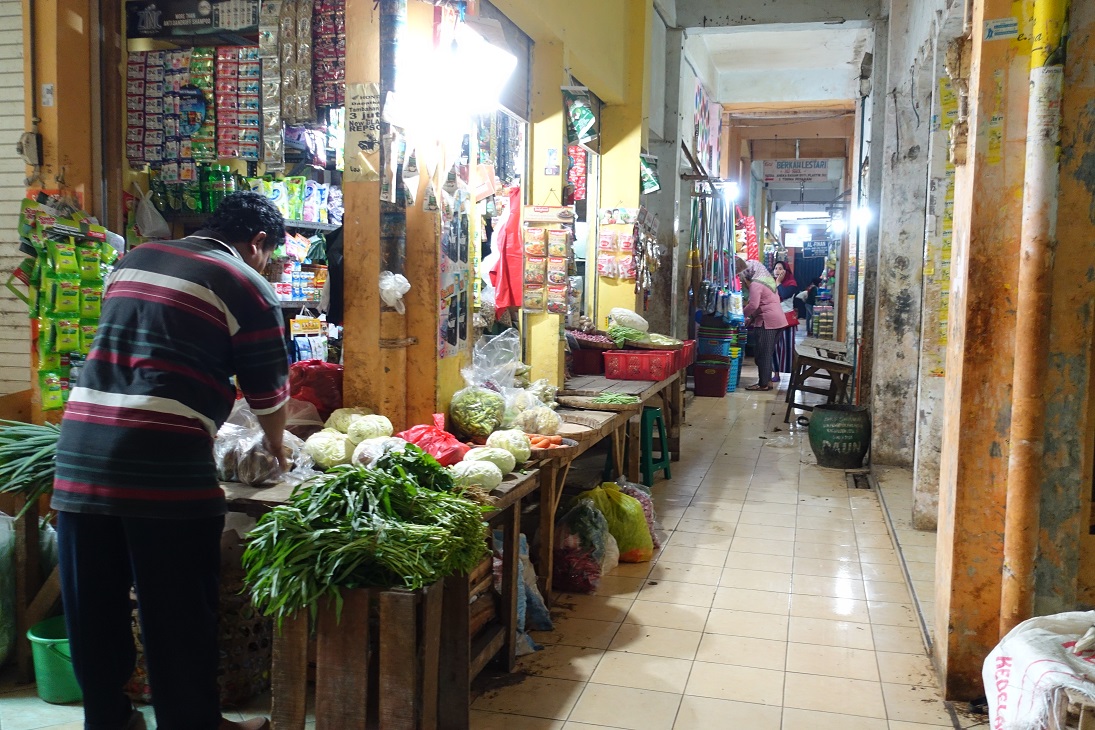
While we enjoyed our 5 day stop here a great deal. We went into town a few times for supplies with our driver Randy. A lovely young man who spoke good English and looked after us very well. Our first day out started with stops to provision at the local market for vegetables, then off to the local fruit stores. Sensational produce was to be had. 


Bruce at the banana stall.

The chicken ladies. These were some of the best chickens we had seen for sale in a long time.

A local fruit and vegetable shop sold terrific array of produce.

In the market a local lady was selling very good cordials.

Each market stall was clean and well presented.
After we returned our purchases to our boats we enjoyed a full day of sightseeing and eating out. Our first stop was to the local aquarium which is inside a huge turtle structure. Turned out we ended up with a 3 year old tour guide who was adorable.


The entrance to the Kura Kura museum.

Inside they had very cleverly construction a simulated diver plus fish - note the arm has fallen off and is resting on the wires.

Poor fish

Our 3 year old guide with his dad who works at the museum.

The shark tank was a tad sad.

One of two turtles in the shark tank.

Bruce at the entrance.
Next stop was for lunch at the famous Beatrice's Cafe which serves delicious food in a funky setting. On the way to lunch we passed a brass and copper shop selling their wares. It was easy to kill time in this amazing shop where the owners spoke excellent English and made us feel most welcome. They were thrilled to have some photos taken with us.


The entire family was thrilled to have Westerns visit their shop.

Bruce found this incredible piece on the shelf, we loved it.

Inside the shop was like an Aldan's treasure chest, amazing.

We had never seen locals with fishing net structures in the rivers like this before,,,we wondered about the quality of the fish they would catch.

Randy at Beatrice's Cafe.
Further along the way we spotted a furniture maker down from the road creating exquisite pieces of art in his yard - incredible. 


A seriously enormous teak chair.

While we snapped the big chair, Bruce noticed these men working in a yard. Their furniture was really beautiful.

Then off to the museum honouring Kartini. An incredible Indonesia woman highly regarded for her pursuit for women's rights and securing the right for girls to be educated in Java in the late 1800's. 


Kartini with her two sisters.

Bruce inside the Kartini museum. It was very well done.

Margie reading me a letter written in Dutch.

The museum also honoured animals. These are the bones of a huge whale that was dug up on an archaeological dig on Kurimunjawa during 1989. We couldn't fully understand the Indonesian plaque but the name of the whale was 'Joko Tuo'.

Minus Jeremy on this day who was busy enjoying Surabaya, this is a bronze head bust Kartini.
After all this driving around the streets of Jepara we needed more refreshments so we stopped at the Sriya Cafe, another incredible place, so interesting. 


Margie enjoying the splendour of the Sriya cafe.

Here we are inside the Sriya Cafe.

Sriya Cafe.
Margie & Randy chatting all things 'band'.
With the help of Lax and his staff, we all topped up with diesel and phone credit while here as well. Their website is http://www.jeparamarina.com/ for those travelling this path.


Lax in the white shirt and son Chris waving us farewell as they head off to Karimunjawa for some R & R.
Jepara in particular is a town full of teak and mahogany furniture makers. It was astounding looking at the many yards full of timber then passing by the yards who turn it into some of the most beautiful and interesting furniture we have ever seen. If only we could have afforded to buy one of everything!!!


There are literally 1000's of teak and mahogany timber yards around Jepara.


OMG look at those chairs!!!!
Our time with Lax and Chris ended too soon and we had to move on further to the east of Java. On the very last day of the month we pushed hard against the current to what is called an open road stead anchorage (no protection). The day light was fading fast so we dropped our anchors in a bay but miles off the coast, only to be treated to an amazing sunset. But sadly our main ripped again.....Onwards to the island of Madura. 

And one more time for the month, she ripped again.


Our final sunset for July was spectacular, the swirling clouds mimicking Saturn's rings.

What have we cooked or baked his month?
This month Bruce's tasty crumpet recipe was well used.


Photo of the month has to be this one taken at Belitung. I think it looks like a lady's head resting on the granite boulders as she looks out over the ocean,,,what do you think?