Bruce’s check list for cruising Indonesia.
The list was put together for several reasons, the first is
because of the lack of factual information. For example the provisioning
information we were feed prior to leaving Australia wasn’t at all times clear. We also wanted to make a list with web links
to make it easier for others, but before brandishing the web addresses around
check them out as they do change regularly.
If your not an Australian or have an Australian vessel please check with your country for the correct details to obtain registration, MMSI, and register your EPIRB.
 |
| Off we go on an adventure of a life time.Adventure before dementia. |
1. Australian Ships Registration.
Before an Australian yacht can check out of Australia and be sailed
overseas it must be an Australian registered ship. Down load the info needed
including the ships name register to check if your vessel name is available
then fill out the forms.
 |
| Ships Registration |
2. 406 MHz Distress Beacon registration AIS transceiver and
MMSI Database.
Before heading offshore you will need a registered 406 MHz
EPIRB. One of the requirements for a
yacht visiting South East Asia is to have a working AIS transceiver. This is definitely
a requirement when traveling through Indonesia and Singapore, yachts have been
stopped by the authorities if their AIS isn’t transmitting. We also know for
sure you need an AIS transponder for Malaysia and Thailand, they run checks and
see your progress. To work (eg transmit)
the AIS will need a valid MMSI number and yacht details programmed into it for it
to be fully operational. If you have Digital Selective Calling (DSC) on your
VHF or/and HF radio you will need your MMSI number programmed in for it to be fully
DSC operational.
 |
| Registered EPIRB |
3. Marine Radio Operators Certificate of Proficiency.
You have the gear now learn how to use it, courses for this
certificate are run by the RYA and most sailing schools. We know a number of
yachts that had radio problems and most have been simple fixes that could have
been avoided by training the operator.
4. Apparatus License and Call sign (Maritime Ship)
Your HF will need to be registered, a lot of people are
moving away from having a HF radio and leaning toward sat phones. While sat
phones are a very effective form of communication, nothing beats a radio net
when there are a number of yachts traveling in a group. Because it’s very rare
for the pack to travel at the same speed the front runners are well and truly
out of VHF range in the first couple of hours. You will also require a registered
Call sign if you want to get a Sailmail or similar account to use the HF to
send and receive email.
5. Passport
and Visas
Your passport must be valid for at least six months from
date of entry for any country so check expiry date. Remember if you’re tripping
from one end of the Indonesian archipelago to the other it’s going to take time,
so I would factor in having at least a year before it expires. That way you
have time to organise a new Passport without the stress of a time line.
Remember if the passport expires you need to start again it’s not a renewal
it’s a fresh passport with all the checks and delays. So if you’re out of the
country it could be a real pain trying to produce all the required
documentation.
Visas, you will need a social visa to be in Indonesia for
over a month. These can be obtained from the Indonesian Embassy in Australia
(or other country) prior to traveling. This Visa can also be extended, this
requires the process to be started 6 days prior to the expiry of the visa, if
the process is not started and or the visa expired you will be fined for the
number of days you are late. If you need to leave the country take your ships
documents with you and apply for a visa on arrival when returning, this is not
the tourist visa and is not free.
You can get a tourist visa on arrival and it is valid for 30
days, but cannot be extended and will require you to leave the country and re-enter if you require to stay longer. This option is good for fly in visitors
and crew.
Checking into Indonesia, There is now a new system in place
and the information needed to check in and journey through Indonesia is at
Yacht’s Electronic Registration System (YachtERS). YachtERS is an electronic
registration system for foreign yachts who will visit the territorial waters of
the Republic of Indonesia.
 |
| Imigrasi Clearance Finished |
YachtERS is an web-based application designed to help make
it easier for foreign Yacht ship owners with online registration process which
can be accessed with
https://yachters-indonesia.id
Foreign yachts ONLY need clearances at first entry and last
exit ports, domestic clearances are not necessary like they once were. The sailing
permit/port clearance certificate issued by Harbor Master at first entry port
covers all domestic travel up to your exit port. So make sure the exit port on
your sailing permit is where you want to leave Indonesia from, not your next
port of call after checking in. We didn’t check this and we needed to have a
new permit issued because the next port of call was listed as our exit port.
Foreign yachts are forbidden from commercial activity within Indonesian waters,
no chartering.
 |
| Document folder to keep your papers together |
6. Australian
Customs & Quarantine.
We found the Customs people very helpful prior to our
departure. When you depart Australia you be given a port clearance certificate,
copy it then keep it safe, you will require this on arrival.
You can get a GST rebate on all items purchased over $300
one month prior to departure this includes medical supplies and boat equipment.
Get an account at the chandlery or save up all your purchases so there is one
bill. Also there is a Wet tax rebate on wine.
https://www.border.gov.au/Trav/Ente/Tour/Are-you-a-traveller
 |
| Customs House Thursday Island FNQ |
When you fill up with diesel prior to departure keep your
receipt as Customs will give you a claim form for a 20% excise refund from the
ATO.
Australian Quarantine: the Quarantine people were very
helpful. Contact the local office for an information package, the Cairns office
is very helpful because of the bio security problems facing the north. It’s good to know what you are required to do
when returning after traveling north of Cairns.
They can also give you procedures to take before returning to Australia
and what your obligations are when you travel in the Torres Strait area.
 |
| On the way to the fuel merchants Horn Island FNQ |
7. Foreign
Currency
The Indonesian currency is the Rupiah. $1 = 10000 Rupiah. Exchange
can be done anywhere in Australia prior to departure, we found Western Union
had the best rates after we had already done an exchange at our bank. You will
require about 5,000,000 Rupiah (yep 5 Million) ($500) to get you started, there
are ATM’s in most large towns in Indonesia. We were told to also take a few
thousand Australian dollars, not sure why there is a need to take AU$ we didn’t
follow this advice but still took a couple of hundred that is now going mouldy
in the wallet. Its way easier to find an ATM than a money changer in most towns
we visited. Once we got to the western end of Flores we did notice money
changers signs, but on the eastern end of the archipelago ATMs are your best
bet. It will really be your call whether to take cash and exchange it, or use an ATM. The bank fees for using an ATM add up after a while. But factor in money changer fees and you may be better off, these guys are not doing the service for free.
8. Charts,
Publication
Some people we talked to do not use paper charts, we do
however and were able to find second hand charts reasonably easy to get. We use
standard official charts and usually travel with the current chart on the table
for quick reference. We also run OpenCPN on a laptop and use the chart plotter in
the cockpit on lower zoom scales.
There are lots of electronic chart options now on the market
and we have found Cmap and Navionics can be lacking in detail, but after
talking with others it appears to be an ongoing complaint with most electronic
charts. Its little things missing like lights, beacons, rocks and reefs. But
also some land masses are in the wrong position, for example several islands
.25 of a mile east etc. It’s a pity these guys couldn’t at least adjust their
charts with the aid of satellite photos. The other thing that does annoy us is the
depth inaccuracies, 5 metres on the chart 20 metres in the real world. Shouldn’t complain about that I guess but it
does make it hard when looking for upcoming anchorages, so plan for deeper
water than marked on the chart. The reverse is also true keep a good eye on
your depth when moving into anchorages, usually the shipping lanes are fine and
depth fairly accurate, however this is not always the case in the less detailed
anchorages.
 |
| On the left is an electronic chart display of reef system, the actual extent of the reef system from a Google Earth screen grab. |
To help overcome some of the inaccuracies in the charts we
use OpenCPN with a google earth chart overlay, this works well when there is a
lack of detail and the chart plotter is showing you anchoring quarter of a mile
inland. If you have OpenCPN try and get your hands on a program called GE2KAP. The
program GE2KAP is named for what it does, makes KAP files from Google Earth
hence Google Earth to KAP.
OpenCPN is a handy chart plotter program and as I have said
previously we have it running on a laptop computer sitting on the chart table
while on passage. Simply connected to the GPS and AIS data streams, we zoom it
out so we get a good idea of vessels and dangers around us. We leave the chart
plotter in the cockpit zoomed in so we have better detail of what’s close
around us and we constantly compare the two with the paper chart. Before
heading out of an anchorage or better still before heading into any anchorage
at a minimum look at Google Earth and create an overlay chart while you have an
internet connection. While these are not always going to show all the dangers
they are a great addition to the charts.
However we have found the discrepancies in the charts can
also match the discrepancies in the Google Earth cloak or blanket or as we have
named it the cone of silence, sometimes you may see half a reef and the rest is
covered. But half a reef is better than not knowing there is a reef there at
all.
 |
| A large reef the top portion has been cloaked, you can also see only a small portion of the sea around the islands is clear of the cloak. |
 |
| The extent of the reef with out the Cloak put in place as in most Google Earth displays, They must have missed this one |
If you don’t have Opencpn don’t worry there is OvitalMap
which is a free down load. You will however need a device with built in GPS.
But be aware some (not all) IPad’s/tablets will not work because they don’t
have built in satellite GPS receiver. A word of warning here, you will really
need to check this out thoroughly before purchasing the device because we know
several individuals who purchased IPads/Tablets on the assumption the unit had
a satellite GPS receiver. They then found out later they had been duped by clever
marketing talking about GPS, however this was not a satellite GPS receiver as we know it
with satellite reception but GPS by triangulation with the phone towers and
WIFI location. If your tablet/iPad required a sim or WiFi to make it active to find your location, most likely it doesn't have a GPS receiver.
OvitalMap is a cross-platform map browser developed by
Beijing Ovital Software Co.,Ltd. based on Google API, supporting offline views
of Google Map, satellite map and terrain map, remember as I said earlier the
down side is the cloak or blanket Google Earth apply to ocean/sea areas.
Some people found iSailor very helpful and did fill in the
chart blanks when others were lacking in detail. iSailor is a marine GPS
navigation system intended for use on iPads, iPhones, Android smartphones and
tablets. Usually available at the app stores for your favourite devices.
OvitalMap
http://www.ovital.net/en/ I am not sure if this is much good these days, a run in with Google due to copy right of the images might mean Google images are no longer supported.
Navionics Electronic Charts
www.navionics.com/ or the App store for
downloads for your device
If you are not OpenCPN literate and are just starting to use
this wonderful tool, Terrys site may be a bit confronting, but take it slowly
and persist to get some great information.
You may also like to head off the here for additional information,
http://www.hackingfamily.com
Lots of factual information from a family who has been cruising Asia for several years, and are real nice people.
Publications
• Cruising the Coral Coast – Alan
Lucas
• Australia Pilot NP15
• Cruising Guide to
Indonesia – Andy Scott
• 101 Anchorages within the
Indonesian Archipelago
• Southeast Asia Pilot
 |
| Some of the guide books we used |
We didn’t
use the Australian Pilot much as its geared more toward large ships, however
AMSA have great guides when traveling north of Cairns right down to planning
chartlets. While mostly for bigger ships we did make great use of the Queensland
Coastal Passage Plan (QCPP) guides and even the way points they have listed for
traversing the reef
https://www.amsa.gov.au/navigation/quick-guide-gbr-torres/
Cruising the Coral Coast was never far from
hand while traveling north along the Australian east coast. Then when we
started to travel the Indonesian Archipelago the other three books were a great
source of information.
 |
| A few of the guide books we took, we also found some along the way at book exchanges cheap. |
Lonely Planet Guide for Indonesia, Malaysia-Singapore and
Thailand (you could try buying these on Ebay or the second hand book shops,
they are much cheaper) However you will need to make up your own mind if some
of the listed attractions live up to the best I have ever seen anywhere in the
world tags. As we have found in our travels, yes it may be good but not the
best we have ever seen, there have been times we have been very
disappointed.
9. Flags
Let’s sort fact from fiction, we have read several times
that when you visit Asia you’re going to need large courtesy flags. We were poorly
informed that you will need a courtesy flag that is much larger than your
vessels home flag. Not sure where this story started and think it has continued
to spawn unchecked, this is only one of many untruths we were told or read
about while preparing for our trip. What a pain in the neck this caused a lot of
us looking for courtesy flags. As we all know flags are not cheap and the
larger they are the more expensive they become. Our idea was to purchase a
smaller home country flag and then find the largest courtesy flag we could lay
your hands on and fly easily. The fact is that once we checked in, neither
Customs or harbour master gave anyone a hard time or disapproved of the size
of the standard courtesy flags flown. I am sure badly made, tatty or micro
flags would meet with disapproval, from our experience the standard size
courtesy flag for the visiting yacht is all that is needed.
• Red Ensign (your national flag) to fit your flag pole,
not up on the spreader (check out flag lore on the internet)
• ‘Q’ Flag, Indonesian, Singapore,
Malaysian, Thailand, Flags 450 x 300
 |
| We got the country flags on Ebay for a good price and they had free postage. |
We did get
our flags on Ebay, we got a good deal with combined postage, the flags were
good for the price. Then once they started to look a bit tatty after they were
up for a while we then looked around at markets or nick nack shops and were
able to get replacement for very good prices.
 |
| Checked in Indonesian flag being hoisted. |
10. Communications
You will have mobile phone connection throughout Indonesia,
Malaysia and Thailand so all you need is an unlocked phone and or a 4G WiFi
mobile modem. Purchase a sim card for both phone and modem and you should have
good communications. For a computer internet
connection use an unlocked internet modem or you can also use your mobile phone
as a hot spot to work with your laptop computer. If you get here and find your
mobile is locked you can buy a cheap one easily, remember you get what you pay
for, however phones on the outer islands may not be as smart as you need. We purchased a 4G modem here for about AU$ 100
this gave us a backup internet connection if the phone went flat etc. The 4G modem also seems to find the 4G signal quicker
than the phone can, some mobile phones don’t have 4G functionality so sort this
out before leaving.
To keep the cost down, buy a phone top up with the largest
amount of internet data you can, then use internet communication apps that use
VOIP (Voice Over Internet Protocol), e.g. Facebook Messenger, Skype, Facetime,Whatsapp
to name a few. You can turn off the video stream to conserve data and help maintain
connection when the connection is limited.
The other reason to get into the habit of using the internet connection
for communication is there are a lot of cafes hotels and bars that offer free
WiFi so use it while you have a drink or snack.
If you need to communicate with your Australian carrier have
the conversations now before leaving, those who didn’t have suffered a long
drawn out process trying to suspend/close/maintain accounts. Be aware that those
roaming charges from your Australian carrier that sound attractive if listed as
a daily amount can become expensive if you don’t read the fine print. The reality is the Australian carriers cannot
or should that be will not come close as far as price is concerned.
In Malaysia we use U mobile and have had
great coverage everywhere we have been. In Thailand we purchase the dtac happy
tourist sim and then top up later to the unlimited option. The rates in
Thailand for phoning AU are fantastic if you follow the instructions on the pack
your sim comes in.
We had to have one of our phones unlocked, after mucking
around with the telco’s hit and miss service we found a company that can do the
job quickly and professionally, just register submit a job and you can pay with
PayPal.
Unlock It Codes www.unlockit.codes/.
11 Other things
Boat Stamp: You may need to get a boat stamp
made for when clearing customs and immigration. It’s a simple stamp with your
vessels name, home port, registration number and if you want MMSI. It is your
vessels seal and like a signature keep it safe and don’t flash it around.
b.
Boat card: This is like a business card only it has
a photo of your boat on it and your contact details.
 |
| Boat stamp and boat cards. |
c. Get
a scanner so you can make a copy of your documentation, a printer wouldn’t go
astray but as usual the cartridge prices are a killer. Take the originals
ashore and have several copies made at reasonable prices.
d.
File all your documentation for quick access in
a weather resistant pouch for taking ashore when necessary.
12. Fuel and
Gas
Diesel and outboard fuel is available on shore or delivered
to your boat via private carriers and you will require jerry cans. We carried 4
x 20 litre plastic cans for diesel (solar) and a couple of 10 litre cans for
the petrol (benzene). There are no fuel docks as we know them.
You will find that when you’re on the outer islands in Indonesia
if you carry jerry cans to the local service station you will more than likely
be barred entry and they will not fill your cans. While this may sound crazy,
the problem is more to do with lack of supply. Check this out before heading to
the service station jerry cans in hand. There
is non-subsidy fuel available for us (yachties) and if you rent a car truck or
bus you can cart your own fuel and the pump price is less than the local
supplier will quote. Keep in mind this quoted price is fuel delivered to your
vessel, if you haul your own you need to factor in the car or truck rental, I
think you will find the delivered fuel service will start to look attractive
but you will need to judge this on the day.
If you want or need to stay with your cans for the service it may be a
long time between fills. While we did receive the odd insect and small foreign
bodies in our fuel, water did not appear to be a problem.
We have a good fuel filtration system for filling the tanks
from the jerry cans. The first choice was a Baja filter, this has 3 gauze
filters and water trap that is very effective in removing the foreign bodies
and water. The other unit we have is a 12 volt fuel pump driven unit that
filters fuel through a pleated paper filter and also has a water separating
trap with viewing glass. The unit can
also do service as a fuel polisher should I need to clean the fuel in a tank. We
purchased the parts to make the fuel polisher in Australia from Repco, I know
Autopro and Bursons have the bits and pieces as well. As it turned out the Baja filter was dirty to
clean out after using it, with the electric unit we were able to dispose of the
filter cleanly with little/no mess on board.
 |
| Electric fuel cleaner used to pump fuel from the fuel cans into the tank, its used with a 700mm length of 8mm copper tube connected to the suction side of the pump and is inserted into the can. |
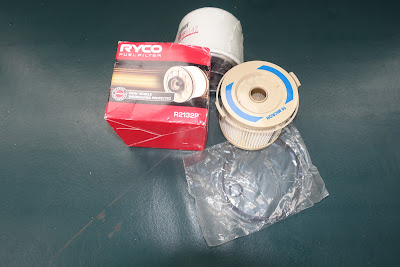 |
| Don't forget fuel filters for the polisher and motor |
The Baja filter would have been ok
if you were on shore or tied up at the dock and were able to dump the waste
into a bin or waste oil point.
Get a good fuel treatment biocide to kill the fuel bugs.
Look for a treatment that will not only kill the fuel bug but also break it up
so it can pass through the fuel system. Very important to have this option,
just in case we do get a fuel bug needing treatment. We use Fuel Doctor
distributed in Australia by Castrol. We also made sure any fuel stored in jerry
cans was treated even though it may have sat lashed on deck for a week or more.
Pack plenty of fuel filters and for those of us who use 10
Micron 2010 Racor filter elements Bretts Truck and filter in Australia have
good price for these very expensive units. 02 43884994
 |
| Before and after, the fuel had already been filtered on fill up |
|
There is no gas refill available through Indonesia so take
enough for the trip up to Singapore, we took 3 x 4.5kg cylinders but should
have taken four cylinders. Our locker can only fit 4.5Kg cylinders so those of
you with space for 9Kg cylinders in the locker, it should be easy to take
enough gas. While 3 cylinders doesn’t sound like a lot of gas we found it went
a lot further then if we were coastal cruising in Australia. For a start its surprising how many times
you will eat out, then it’s a lot warmer here so slow cooking and use of the
oven was greatly reduced.
If you do run out of gas, 3.5 Kg local cylinders are
available for purchase for about 280,000 RP (AU$28) a regulator costs from 50
000 – 130,000 RP and could be plumbed in with the use of a 3/8 barb into your
gas solenoid. It’s just a thought, and if you intend to be in Indonesia for a
while it would be easier and safer than trying to go down the cylinder –
cylinder equalisation route.
We did buy a local Malaysian cylinder and regulator. It’s a
big bottle and took a bit of thinking about where we would put it. But 14Kg
goes a long way, we did eventually get our Australian cylinders filled and
they now are a backup should we be caught with an empty.
Here is how we fitted a Malaysian Gas Cylinder:
http://svmatilda.blogspot.com/2017/07/fitting-asian-gas-cylinder.html
13. Equipment
Below is some of the equipment fitted on ‘Matilda’
• VHF Radio: DSC capable is great for
calling friends and auto selecting the talk channel.
• HF radio – for weather reports and
keeping in touch with other vessels and land bases outside VHF range.
• AIS must be transceiver type
programmed with valid MMSI and vessel details.
• Chart plotter with up to date
electronic charts.
• Tablet with Chart plotter software with
up to date electronic charts
• Auto Pilot a must for long
passages.
• EPIRB 406 with built in GPS – must
be registered to your vessel with AMSA (or your resident country).
• Inflatable life jackets with built
in harness for each crew member.
• Jackstays, tethers
• Life raft.
• Water Maker but potable water is
usually available it in 20 litre bottles, you will need to purchase and cart it
• Solar panels more is better with
these
• Wind generator
• Good tool kit
• Tow line and sea anchor (drogue)
• Anchor Chain, nylon anchor rode
• Anchor drag alarm of some sort eg
handheld GPS or GPS enabled smartphone with App
• Covers
• Batteries: Make sure they are in
good order
• Have good fans (One most likely won’t be enough) in each cabin
• Have quiet
fans in the bed room one at the head and one at the foot of the bed.
Anchoring: You will
often anchor in 15 to 20m sometimes more, so you will need at least 80m chain,
and you could have 100 metres of nylon anchor rope as backup, this can double as tow line
and drogue line.
We were told a lot of different stories regarding anchoring; one couple who had been to Asia on several occasions really rattled our chain in regard to anchoring and having enough anchor rode. We were at a point where we were starting to doubt our preparation. Luckily we meet others and after talks with them it put our mind at rest, we had 110 m and as it turns out that was plenty.
Don’t beat yourself up here thinking you’re going to need
heaps of chain due to the depth. Remember this method really come in to its own in the deeper water. Depending on your anchor (new generation is best), when anchoring in deep water lay out 20 metres of chain, then double the depth, yep this sounds crazy but works a treat, so in 20 m of water 60 m of chain. If it looks like the wind is going to be up drop out 10-20 m more and don't forget to use a good nylon rope snubber. In the deeper water you can forget the usual scope ratios discussed a lot. If you want an explanation go here for a presentation given to Fremantle Sailing Club, they do it slightly differently (15 m of chain not 20 m to start). One of the presenters Kim Klaka, is a naval Naval architect and yacht designer and has done anchor trials and written about safety and anchoring.
Wind generator: verbatim I will quote what one person told
us before coming into Asia” the wind generator is useless, useless I tell ya
cause there is no wind”. Not sure about that, we have made excellent use of
ours.
The sun in the tropics can be very strong so you need plenty
of shade and also when it rains you want to be able to sit in the cockpit and
leave hatches open. Small silver tarps also work as temporary shade where it’s
needed.
We have a Spectra water maker that produces 55 litres per
hour and we have had the odd problem over the last six years. If you plan to
use a water maker but you are not using it now and its pickled, un pickle it, get to
know how it works, then use it on the warm trip up the coast. Get a spread
sheet together and log the pressures, voltages, output and sea water temp and
product quality every time you use it, so when things start to change you can
see what’s normal and what’s not. You can also look back over your log and see
gradual change or in the case of a failure a large change.
14. Spares
This is a very simplified list, and really only highlights
things we know people have needed.
• Rope for sheets and lines,
shackles, rigging bits and pieces etc
• Globes and fuses
• Engine service kit. Engine oil,
filters, belts, impellers at least two of each, Fuel filters x 10
• Fuel Hoses
• Raw (sea) water pump rebuild kit
including all seals and bearings
• Motor circulation water pump
• Spare propeller
• Outboard service kit, spare prop
• Alternator, Starter Motor, external
regulator if used
• Domestic fresh water pump, filters
• Gas bottle regulator cannot use gas
without.
• Bits and pieces for steering
(hydraulic and cable fittings)
• Spare anchor
 |
| Just a small cross section of bits and pieces we carry |
16. Provisioning
Let’s start with something none of us can do without. Water,
Filtered treated drinking water is available in most of the towns you will
visit. We did purchase water in 19 Litre containers (the round type used in an
office water fountain called Gallons) when we didn’t feel the water was clean enough to run
through the water maker. Some cruisers without a water maker didn’t have any
problems keeping their water tanks full.
 |
| Just a small cross section of vendors at the local fruit and vegetable markets |
There is a lot of information out there online about
provisioning when in Indonesia that is just plain wrong, it may be written in
blogs or in stories people have told about their journeys. I can see how some may have come to certain
conclusions. However with common sense you should know you are not going to
resupply or get enough food and supplies for a month in a small fishing village
on a remote part of the archipelago. A note here; small fishing villages don’t
usually have much in the way of produce for sale. This is not to say they won’t
have something but you may find they only have fish, coconuts and bananas for
sale or barter. Head into some of the bigger towns and you
will find it’s an easy thing to get supplies. We even read that it was almost
impossible to get full bars of soap, bottles of shampoo deodorant and toilet
paper. But you can, just don’t depend on a small store a metre square set up in
front of a house in a remote village to make your unwashed crew of four smell
pretty. However don’t over stock before heading offshore because you can
purchase like or brand name products at half the price. Someone who should have known better even
told us we will need to get used to palm sugar because that is all you’re going
to get. The same person also told us we will have trouble getting rice because
it’s in such high demand. Really, what a load of drivel there is plenty of staple
food supplies including sugar and rice available. You can even easily buy green coffee beans if want to roast your own.
Bread in the eastern part of Indonesia is slightly sweet, we
didn’t mind the taste but it wasn’t much good with vegemite however toasted and
covered with jam and honey it was very tasty. So if this sweet loaf idea
doesn’t excite you then include lots of bread flour so you can make your own.
There are supermarkets in larger towns that offer vast variety of foods, soft
drinks, biscuits, crackers, powdered milk, butter and beer.
Here is how we make our bread while on the go: Bruces No Need Bread
Head to the traditional markets where fruit and vegetables are
usually cheap and easy to get, and the range isn’t much different from
Australia. We didn’t know what to expect and as usual we were poorly advised
yet again, we were lead to believe we would need to learn how cook a whole new
range of foods. Well the good news is there isn’t much of a difference. To name a few fruit and veggies available in
most stops, potatoes, onions, shallot, spring onions, garlic, ginger, tomatoes,
cucumber, beans, carrots, cabbage, eggplant, pumpkins, corn, chokos (Chayote),
bok choy, pak choy, bananas, coconut, water melons, rock melons, mangoes,
pineapples, apples, nashi pears, papaya, oranges, limes. At the local markets
you can usually buy fresh eggs, take your own carry box. A small note on the
eggs. Take a powerful torch to look
through your eggs before purchase to check for any spots. Rice, lentils and dry
beans are available by the kilo in most markets.
 |
| You should be able to find most of what you need at the local markets, but perhaps not at just one stall so shop around. |
The trip to Indonesia can take about three – seven days depending
on your departure and arrival ports. So you’re not going to need a lot of
supplies for the trip. You will however
need to think ahead and take supplies for the time you intend to be traveling
through the archipelago. Keep in mind that there are great restaurants and
café’s when you get there. You will need
to decide if you’re going to cook on the boat or head into shore to find a
restaurant. This will dictate how much meat you will take unless you have a
freezer. If you have a freezer then you may like to take as much meat as you
can, visit your butcher a couple of days before departure to allow time to cryovac
and or freeze serves. Bacon and processed meat isn’t easy to get so if you like
these products then you will need to stock up before leaving home. Now the reality check, freezers will use a
whole lot of power in the tropics, so you will need to weigh up the convenience
of having a couple of steaks on board with the inconvenience of consistently chasing
power to feed the freezer.
Cheese, butter and milk (either powder or UHT) is available
in limited range in the supermarkets before Bali, however they are expensive so
stock up with about two months supply before leaving. We stocked up on the
usual tin food, dried food, breakfast cereals, powdered milk, juice and toilet
paper.
Beer (Bintang) in cans and bottles is available at most
stops but it is not as ridiculously cheap as we were lead to believe, we can
still home brew for a whole lot less. However when compared to what you would pay in Australia, the prices paid for drinks when eating out it is very cheap. As a heads up when ordering at the restaurant
ask for “Bintang dingin sekali” which translates into a Bintang that’s glacial,
frosty, ice cold.
If you like drinks mixed
with tonic water take plenty of tonic water. Buy required quantity of duty free
spirits and wine for three months because wine is hard (nearly impossible) to
get east of Komodo. Then it’s available its very expensive, and keep in mind
wine in bottles lasts better than in the cask. Some including us were half way
through the trip to find their casks of wine had turned to vinegar, well come
to think about it the wine was off at about the 4th or 5th
stop. When coastal cruising we have our soda stream so we have a good supply of
soda water on hand. So we thought great being a world-wide company we
researched and found gas refills were available in Singapore. However the bad
news is the bottle thread is not the same as fitted to the Australian gas
cylinders. So you will either need to buy a new unit (very expensive) or
purchase bottled soda water when available, a cheaper option but a pain to cart
and store. One cruiser before he left Australia went off to the home brew shop
and secured a CO2 bottle and adapter to make his soda stream go for a long
time. We believe he was able to get the CO2 bottle refilled in Malaysia.
17. First Aid
We recommend that the starting point of your first aid kit
be equivalent to Category 1 without the prescription drugs. Then go and have a talk with your doctor. We
were going to load in the different narcotics and pain killers but didn’t.
While it all sounds great to have these powerful drugs it could also cause
problems because we have no medical training other than offshore first aid. We
have friends who are nurses or have medical training and pick up the drug list
and can say yep this is good and this is used if there is an over dose of this
other etc etc. Well this is all well and good but we thought it would be safer
if we don’t have the controlled substances on board. It’s hard to give an over
dose if you don’t have the dose to start with.
The reality is there are doctors in Indonesia and if we need help it’s
not weeks away.
Note: You will need a letter from doctor stating that narcotics
and pain killers etc. have been dispensed for emergency use only during
prolonged offshore cruising. That is of course if you can get your doctor to
approve purchase of any of the more powerful drugs.
 |
| First Aid kit kept together in containers, this will be examined for out of date items on arrival. |
18. Personal
Safety
Visit and have a good talk with your doctor well before
departure and check that your immunizations are up to date. Well before
departure means you should ideally start at least eight weeks or earlier before
departure, some vaccines need a follow up so allow time to have the whole
course. While at the doctor discuss what would be the best malaria protection
for you to take. Some couples were taking the malaria protection from day one
when they departed Australia, others like ourselves didn’t start until we were
headed to Borneo. There are known hot spots that change with the seasons and your
doctor has access to this up to date information.
While we didn’t take the malaria protection medication (until we went to Borneo) we
were continually vigilant and wore light coloured clothing when going to
afternoon functions that would roll over into the dark. We took good insect
spray (the type with deet) and put it on before dusk. Our vessel had insect
screens and we would burn a coil or use a 12 volt insect burner that took a
small blue rectangle impregnated with insect repellent. A lot will depend on
your anchorage. Some anchorages there will be very little insect movement but
at others you will need to be careful.
We and others found the following helpful: Mosquito coils,
screens, spray, mosquito nets to sleep under. Dont buy years of insect control chemicals including coils and the little blue cards for the electronic insect control pads, you can buy the same in Indonesia for a quarter of the cost.
While we went off to the doctor and either had or had
boosters for the following, Rabies, Japanese encephalitis, Hepatitis A and B,
Typhoid we know of others who didn’t so discuss this with your doctor and see
what they recommend. Japanese encephalitis vaccine is used for high-risk or
long-term travel in Asia, its spread via mosquitos and can be very nasty. If travelling where rabies exists and animal
exposure is possible, consider pre-exposure rabies vaccine, the threat in
Indonesia is from dog’s cats and monkeys. From our experience when you go to
the chemist in Queensland with a script from your doctor for rabies vaccine
there is usually 2 doses in stock, but you will find they are different brands.
When you get the shots keep a note of who had what brand so you can continue
with the next booster.
Check the smart traveller web site for lots of good
information on health and vaccinations.
Personal safety ashore, don’t be rude or raise you voice. If
you don’t want a taxi (after being asked 20 times by different drivers) just
say no thank you, the locals are not aggressive so please show some respect.
If you feel uncomfortable remove yourself from the situation. Keep an eye on
your personal items but I think you will find if you don’t flash around money
or goods you won’t attract attention. I remember a comment one of the French
cruisers said to us one evening that he had been able to relax and not have to
guard his possessions like if here were in Europe on a trip, if he did what he
was doing here in Indonesia they would have all been taken.
Lock your boat up when going ashore and put away loose items
like torches and fishing rods, just be vigilant. If you are going ashore for a
trip for a couple of days have someone in the anchorage look out for you
vessel. We paid a fisherman/fuel
supplier a daily rate to look after our vessel when we went off on a trip for
six days and he even picked us up and returned us to the vessel included in the
price.
19. Trading
and Gifts
Giving gifts, this is starting to become a problem. While it
all sounds great to give things to those who we think (our perception) don’t
have much. Think about the flow on effect after 3-4 vessels come in showering
all with gifts, it quickly becomes the norm and if the next vessel cannot give
as much or the same quality the scene can become tense. While we did get mobs
of kids coming out to the vessel we know of one couple who were harassed on the
beach by adults with demands for clothing, gifts and money to the point of them
feeling uncomfortable. We had something simular happen when a pack of exercise
books we were going to donate to the local school was noticed in our back pack
by some kids playing in the street. In the matter of what seemed like seconds
we were surrounded by dozens of children thinking we were giving books away,
this was becoming a mob scene and we had to slip away quickly. So if you are
headed to the local school to donate keep what you donating covered up on the
way there. Bartering stuff - we traded exercise books and pencils with the
children for we meet on our travels. Adults may bring fish, coconuts, bananas
out to your boat so offer a fair price and negotiate a final price with them.
We have heard of people taking out of date medication to
give away, why? if it’s not good enough for you why would you give it to someone
else. Be careful of what you’re giving
away. If its medication take it to the hospital/town doctor don’t just hand it
out. Most of the dosage instructions are in English so giving medication to
people who don’t speak English is only asking for trouble. You may even find
that during the check in process your medication will be checked, and out of
date medication will be confiscated. Perhaps this was due to previous problems
caused by cruisers thinking they were doing a good thing, but in reality we
poisoning the local population.
Gifts for the children are better given to the school for
distribution. Things like exercise books and pencils, eraser, sharpeners,
tennis balls, soccer balls, volley balls, educational toys and games, if you
giving away ball that needs a pump, supply the pump and show them how to use it,
don’t ever ever give money.
Some of the things we learn:
Do not be confrontational, there is a code of saving face in Asia, so confrontation will not help any situation.
Change the menu at the restaurant at your own peril. Even though the waiter smiles and nods, in a lot of cases they have no idea what you just said and don't want appear unhelpful. They will possibly go back to the kitchen and say the lady at table wants some thing to do with spicy but I didn't understand.
Expect lost in translation moments, we ordered 6 cokes and was served 6 coconuts, turns out they didn't sell coke and we didn't read the menu fully. The coconuts were cool and delicious, and better for us than coke.
Keeping off the shore to stay away from fishing activity
worked well for us on our journey. On our way to Tual we didn’t see any FADs (fish attracting device)
until we got in the channel between the islands. So keeping to the centre of a
channel or in deeper water can help, but it does require a good look out with a
high powered spot light or torch regularly flashing it around to spot any
upcoming hazards. During our run up between the Kia islands we kept on the two
hundred metre contour and had a good run. We found a number of fishing huts are
manned at night and when we approached, some would shine a powerful torch in
our direction to get our attention then would flash the beam across the water
over their net so we could steer away if necessary. Most of the time the nets
would be laid from the platform/canoe/dingy/fishing boat to the shore and to
make the end of the net float a little less visible to us they fly a black fag
on the bamboo pole float.
 |
| A typical fisherman's hut built in the water |
 |
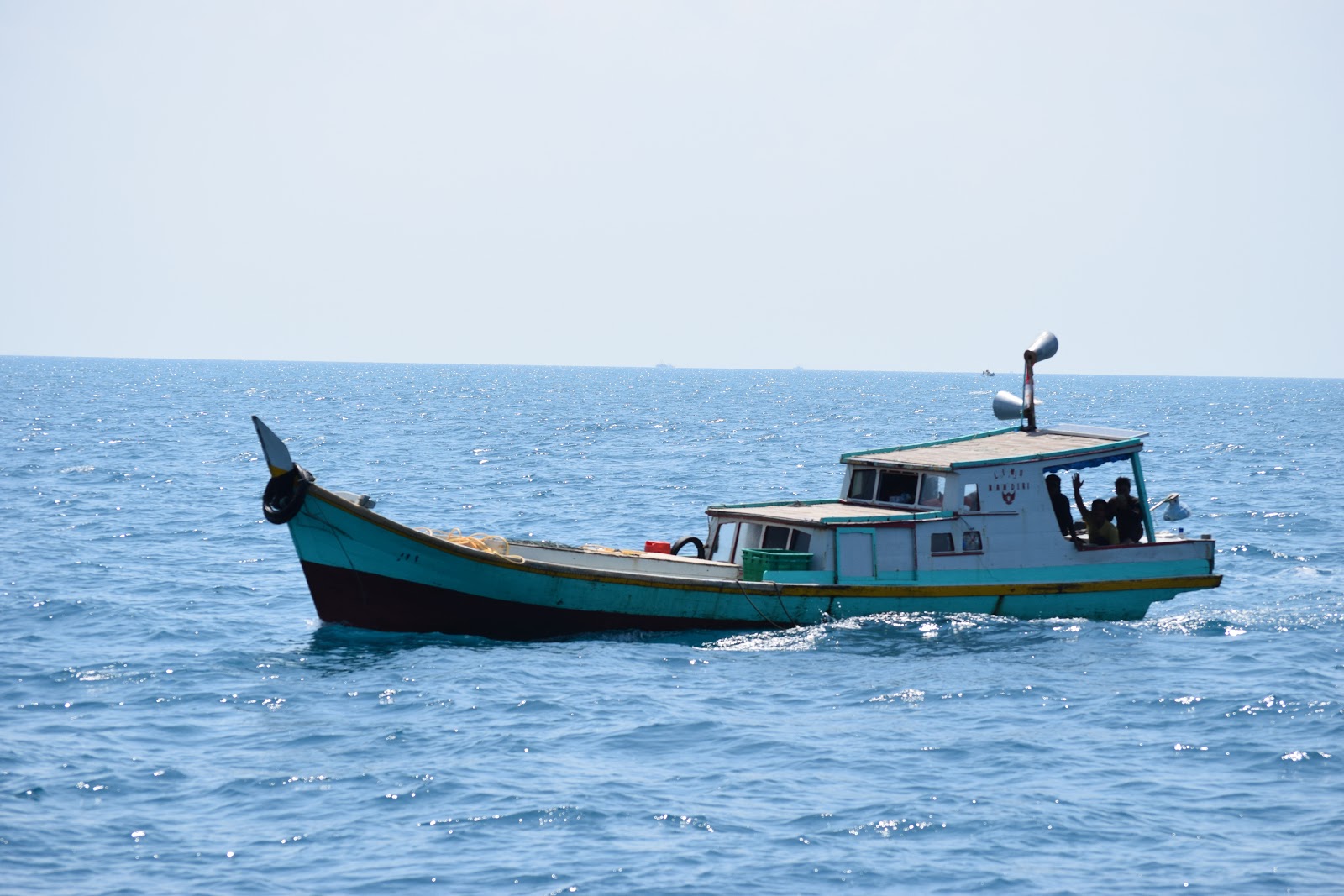
| Small Indonesian fishing boat, coming close to have a look |
Crew member taken on just before the start of an ocean
passage wasn’t the smartest thing we could have done. While we have sailed
together it was only short runs, if contemplating longer voyages have the
candidate travel with you for a coastal leg to get sea legs. For us three hours on and three hours off during the evening
was almost torture, once we went to two on and two off it went by in a flash
and we seemed in better condition in the mornings.
The tide function on electronic charting apps
(applications/programs) can be out by hours, while the app is showing it’s a
rising tide in actual fact it may very well be a falling tide. Try and find a
tide book or reference before moving into areas you need tidal information.
As strange as this may sound, relax, take in the sights and
sounds, from our experience people coming to help you are not looking for
handouts believe it or not they are just being friendly and helpful.
Stay away from the land. Yes we were either very
lucky or got it right. We gave PNG a wide berth, fifty miles at all times. The incidence
of long lines and drift nets is getting worse, it looks like the fishermen from
a lot of different nations race into international waters and cause havoc as
they don’t appear to follow any rules. Are they poachers, possibly but information of what you see needs to be reported to the authorities.
 |
| The longer your painter the more tenders can use the one tie off point |
Your going to need a long painter on your tender, yes the docks are small and there are usually a lot of tenders, this is a big dock, quarter the size of the dock and add another twenty tenders and you will get the idea.