On board special use grease "Triple One" compound (111)
If there is one on
board grease that I have found to be helpful time and time again it
has to be triple one compound. I first got introduced to it when I
was working in the desert in the 80’s, at the time we would use it
for a multitude of jobs and due to the heat we needed some thing that
wouldn’t vanish and run off when the sun came up the next day.
Plumbing, assembly of o’ ring components, and fit ups of urethane
insulated wire components, and under the bonnet of the work trucks
for a variety of jobs. When my job took me offshore I would use this
grease again for a multitude of jobs and we went through tubes and
tubes of the stuff. We mostly used it to aid the door seals of
electrical housings and navigation buoy hatch seals, aiding the assembly of electronic component
housings, joining the high voltage cables that would ultimately be
towed behind the vessel at various depths. We even used it to help
the porthole rubber seals slide easily into place when we dogged them
down so they wouldn't leak. I have used it on modern yacht hatches where the acrylic hatches seal against a rubber seal. This allows the rubber to bed onto the acrylic and when the hatch is open it helps stop salt forming in the very fine coating of grease on both surfaces.
Here is a compound to make boating life easier, it has a dozen or
more uses on board here are a few of them.
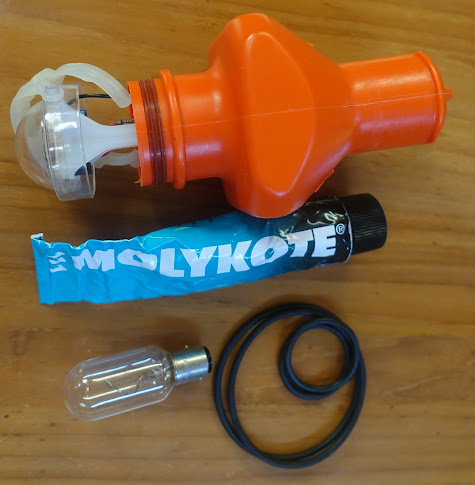 |
| Great for a variety of assembly jobs and protection of important electrical components. |
Triple one compound,
primarily it’s food grade silicone grease and can be used as a soft
sealant for shipboard equipment subject to washing and harsh
environmental exposure. It’s great as a chemical barrier coating
for electrical connections. Good resistance to most chemicals and has
a wide service temperature range -40° C to 200° C. It prevents
gaskets from sticking to metal and resists weathering and water
washout. It can be used as a sealant for vacuum and pressure systems
and is a lubricant for rubber and plastic O-rings, gaskets and seals
and due to the high melt point can be used on hot or cold systems.
It’s not a lubricant for metal to metal, so don’t use it on metal
threads unless you want galling.
Use sparingly to
lubricate the nonmetallic components of the fresh and salt water
systems. When assembling taps, ball valves, replacing tap washers,
fiber washers and O-rings, works well for pump impellers, pistons,
gaskets, sea strainer assembly, importantly it’s great when
assembling toilet components because these are both a vacuum and
pressure system. Like lanolin it won’t attack rubber or synthetic
derivatives like petroleum based compounds can. Having trouble
sliding a hose on a barb, a little on the barb and the two should go
together easily.
It’s great for
assembling electronic /electrical bits in a harsh shipboard
environment, to help control corrosion lightly coat the surfaces you
want protected. Use it on the seals when replacing the tops of
lifebuoy lights, strobes and waterproof torches as it resists
weathering and water washout. When assembling navigation lights the
grommets or glands can be troublesome, a wipe of grease and the job
becomes a lot easier to get the wire sliding into the gland or
grommet, improve the corrosion resistance of the wire by dipping the
stripped wire into the compound before assembly into the screw down
clamp this will keep the moist air out and slow the wicking of water
down the wire. A smear on the bulb base will help stop the corrosion
between the contacts and it will also help stop tracking between the
poles due to moisture, great for incandescent bulbs due to the high
melt point. Use it to lubricate port hole/hatch seals, the gaskets
are able to seal when the acrylic or frame doesn’t stick to the
seal. Use it on battery terminals and cable lugs like you would use
Vaseline, but due to a wide service temperature range it will keep
its shape and not melt away due to the heat from charging, or engine
room heat. If you have a screw to insert in a hard to reach place a
little dab on the screw head to hold that screw on the end of the
screwdriver (of course there are screw starters for this job but
this is a great stand by)
Used as it is
supposed to be used, mainly making rubber and plastic components
slide together its worth its weight in gold. As a warning and speaking from experience keep in mind it is
not for metal threads, it will almost instantly bind stainless steel
screw threads together. My suggestion for stainless steel threaded
components is the use of lanolin grease or a metal component anti
seize
A post detailing Tef - Gel Vs Duralac is here


