About seventy vessels more or less in the anchorage a big storm and a muddy bottom. A night of mayhem ending with bruised and battered boats. In the cruising community there are still things to learn about anchoring. I can safely say we are not experts and we did increase our knowledge from what we learnt that night.
The
Sail Indonesia rally fleets joined others who had sailed and motored
in from different parts of Indonesia, Singapore and Malaysia to be
part of the marine festival celebrations. We were all anchored in
the Tanjung Pinang anchorage and by our calculations we estimated
there was about seventy vessels more or less in the anchorage on the
final evening. The vessels ranged in size from something that looked
like a floating block of flats to small sixteen foot cabin cruisers.
This is a well-protected anchorage for anything other than weather
coming in from the west. So after the day’s hectic social events we
were enjoying a drink and winding down prior to heading back out to
the boat. At around midnight we noticed the lightning on the horizon
to the west getting closer and knew from recent experiences a storm
front was on the way. Oh great that’s all we needed was the cry as
drinks were left unfinished. There was a scramble to the tender dock
and before the last boat had left the dock the waves were already
quite choppy and it was hard to board our tenders. We were lucky
enough to get back to the boat relatively dry and tied the tender up
tight off the stern in case we needed to do any manoeuvring later.
 |
| Stormfront on the way out of the West. |
VHF crackled warning others they were not holdingThen it was on, it started with an icy cold breeze and large claps of
thunder as nature unleashed her fury, the heavens opened up, rain
poured down as the wind rose to a crescendo and the rigging whistled
as the wind strength exceeded forty knots. As the storm progressed
so did the wave height, it wasn’t long before there was surf
rolling through the anchorage. Boats rose on the wave peaks straining
on their anchor chains, the wave would pass and the boats surfed
slightly down the back of the wave before the next wave lifted their
nose pushing them back to strain on their anchor chains again. The
VHF crackled with different boats communicating with neighbour's or
warning others they were not holding, then there were the boats
trying to untangle anchor chains and what to do next.
 |
| The storm is increasing looking west over to the ferry terminal, |
Seventy five percent of the boats in the anchorage dragged.
For
the next three hours about seventy five percent of the boats in the
anchorage dragged. Some of the dragging vessels smashed into others
and took out or dislodged the anchors of vessels that were not moving
so as you can imagine it was mayhem on the water. We had several
vessels anchored around us and it was nerve wracking trying to raise
the sleeping occupants as their vessels were on collision course with
us or other vessels. I remember one comment a friend told us when
they rose from bed disorientated and looked out the porthole of their
vessel as it was dragging backwards through the anchorage. She
commented to her husband that all the boats are hastily leaving the
anchorage dear, so please get up quick and have a look. A look out the
port hole was all he needed before urgently crying get up on deck
they aren’t leaving we are going backwards, let’s start the
engine or words to that effect!
 |
| Just about past waves and wind have died down |
There was a lot of damage to vessels
In
the morning once things had settled down we went out and had a drive
around the anchorage in the tender. We wanted to see how our friends
went during the storm and did they require any more assistance. The
rally fleet participants were very concerned because there was a lot
of damage to vessels that night. One local vessel sunk not far from
us and one of the participants on our rally had their vessel end up
perched on the stairs of the local ferry jetty. It’s funny but not
the ha ha type of funny, but the peculiar funny, it’s how you
notice things in a different light the morning after a night of
chaos. The one thing we did notice in the tender ride around the
anchorage was the lack of snubbers or the incorrect use of snubbers
on a large percentage of the vessels in the anchorage. However this
wasn’t the first time we have notice it, we have seen it time and
time again when we are in Moreton Bay with boats going every which
way (usually with the wind) during a storm or a bit of a blow.
 |
| The local fishing village, several boat sunk including a large tug tied up at one of the docks. |
While the owners were on shore their vessel was re - anchored
Once
you get a group of yachties together for a couple of months, if you
take a little notice patterns start to emerge. Throughout the rally
one vessel always moved when the wind came up, and the morning before
the big storm while the owners were on shore their vessel was re -
anchored after it was found moving backward through the anchorage
again about to collect another vessel. The person who re-anchored it
was another catamaran owner and noticed their bridle wasn’t set
right nor was there enough chain out for the conditions. So he
anchored the vessel as he would his own cat, and possibly for the
first time, during a storm this vessel didn’t move. The owner was
so impressed he actually asked for hints and tips, because in his
words “this is the first time we didn’t drag in a storm” he
didn’t think it was possible not to move. No wonder he was always a
nervous wreck as soon as the wind rose above ten knots.
Tests are conducted in a controlled environment
Over
the years I think we have all read the results of the last round of
anchor tests. I wouldn’t be alone in saying that I actually bought
a magazine to read the test results. Then on the strength of these
tests some of us have then gone out and paid large sums of money to
get the anchor that turned in the best test results on the day. While
it’s great to buy the anchor that comes up as the best with
exceptional holding, it won’t however be the best unless it’s
used as part of a whole anchoring system. As you know these tests
are conducted in a controlled environment and usually but not always
only measure the holding or drag exerted on a load cell. This doesn’t
test a whole unique anchoring system. The whole anchoring system is
rarely tested and really unless it’s a high volume production
vessel with identical systems, more than likely the anchoring system
you have on your vessel will be unique.
You may find it doesn’t hold as tested
So
if you buy the top rated anchor, tie on a length of rope and drop it
off the front of your vessel, you may find it doesn’t hold as
tested. So you start cursing the tester and his report. However, if
the anchor is part of a whole system built up of several carefully
selected components, you may well find the steel vessel, because they
are heavier than any other aren’t they? To which the said anchor is
attached doesn’t budge even through a full blown gale in an ebbing
spring tide in a muddy river during a flood. So one of the components
for an anchoring system is a snubber, don’t let the name fool you
it’s a very important component and does a great deal of work if
set up correctly. Dock line snubbers are not the same as an anchor
snubber so please don’t confuse the two.
 |
| The wrong place for a mooring springer, in reality this isn't going to do much and with loss of tension the chain hook will fall off, there is nothing holding it on. |
Points
for having a snubber
1. The
snubber bridle removes the wrenching jerking motion on the anchor
chain and in doing so softens the yanking motion on the anchor giving
it the greatest chance of staying put in the sea bed
2. The
snubber bridal takes the anchor chain strain off the windlass gypsy
reducing the stress on the windlass installation and wrenching on the
bow roller
3. Allows
the load to be taken by the cleats or other method designed for high
loads
4. Noise
is greatly reduced down below because the load is transferred to the
cleats via the snubber
5. On
the average size cruising vessel the catenary effect from the chain
does not provide any significant shock absorption once wind speed
negates the effect
6.
Helps protect the hull when the vessel moves forward over the rode,
in most cases only the snubber rubs on the hull not the chain saving
the top sides paint
I
would say most of us have heard it suggested that when using all
chain rode the catenary effect of the chain sagging because of its
weight will provide sufficient shock absorption. While this might be
true for larger ships with anchor chain links the size of cars and anchor in deep water, the
catenary effect from the chain on the average size cruising vessel anchoring in shallower water will not provide any significant shock absorption, just look at the
chain shape in a breeze > 25 knots you see that the catenary
effect is no longer a factor because the chain is pulled tight in a
straight line. So simply put, the use of a snubber ensures that your
anchor has the highest chance of staying put where you placed it.
I will add a disclaimer here, this lack of catenary effect is mostly due to the depth we as cruising yachts like to anchor in, the shallower the depth the less likely catenary it is going to come into effect. Deeper water will certainly help due to the weight of chain hanging in a loop, gravity will be doing its work. The shallower the vessel anchors the less likely catenary effect will come into play. So with this lack of catenary effect the shock loads are certainly increased on the anchor and this is why a snubber is so important in shallower anchorages. A springer is still important in deep anchorages but comes into it own in shallow(er) anchorages. Also keep in mind chain weight, high tensile chain may save weight but also lessens the catenary effect, is more brittle and is likely to snap rather than elongate.
 |
| Just on 25 Knots chain is pulled straight beyond the snubber Dyneema loop in use |
Naively the owners drop the pawl onto the gypsy / capstan
We
have noticed that a lot of people don’t realize that a snubber must
have good elasticity, because there are so many in use that don’t.
Take a quick look around the anchorage next time the wind pipes up.
You will more than likely see one or two vessels with no snubber and
the chain is just held in place by the winch and naively the owners
drop the pawl onto the gypsy / capstan that was meant for use only
when operating the winch by hand. In a good blow the excess force on
the pawl has been known to break the pawl bolt clear out of the winch
housing casting letting the chain run free. I know the instruction
manual with my winch refers to this and it states that this pawl
should never be used to lock the chain gypsy rotation as an anchoring
method.
Look
around some more and you will see that there are vessels straining at
the anchor (anchor chain in a straight line from snubber to anchor)
and the small chain loop behind the attached snubber hook does not
change. There is no shock reduction other than the load is removed
from the anchor winch. This lack of elasticity is a problem that may
be traced back to the length of the snubber, some are no more than
400-600 millimeters long while others are of the wrong rope type or
the rope is too large a diameter to allow any stretch.
 |
Heavy rope with a small loop wont do much good
Hull damage due to chain scraping top
sides during wind over tide |
Unfortunately,
the majority of discount chandleries sell silver rope as an anchor
rode because it’s cheap and then it starts to become the rope of
choice for all things anchor on some vessels. This is a bad state of
affairs, silver rope may be ok for the weekend power boat that is
driven right on to the beach, but it is not the rope of choice for
anchoring larger vessels in any weather.
 |
| Silver rope is furry when new and in most cases when its no longer furry it is getting too old and from my experience past its use by date |
We
wanted a snubber system on our vessel that would work and was easy to
use, as stated earlier it had to add sufficient elasticity to reduce
shock loading on our all chain rode and remove the anchor chain load
from the windless. Another requirement was to make sure it didn’t
require additional consumables or an additional task other than
removing the attachment during deployment or retrieval. We wanted the
snubber to be long wearing, virtually maintenance free and we didn’t
want any slipping on the chain. Furthermore, I didn’t want any
dissimilar metal contact for example a stainless steel hook on a
galvanized chain. Due to vessel design, I needed it to run over the
bow roller when deploying and or retrieving the anchor chain with out
causing damage to the roller cheeks.
 |
| Not a very good setup, this arrangement wont do much to help with holding, I am not 100% sure but it looks like a shackle holding the rope to the chain, could be difficult to remove in a hurry. |
Traditionally
snubbers have been attached to the anchor chain with a variety of
snap shackles, quick release hooks, steel chain hooks and purpose
made chain attachment plates. All are proven to work, however some
are better than others, but they can also have some downsides as we
found out. Large snap shackles and quick release hooks can straighten
out or become badly distorted if put under too much load. Exceeding
the SWL (safe working load) if certified can lead to total failure or
distortion of the hook. We have had the steel chain hooks wedge onto
the chain after being anchored in a decent blow. The other pitfall
with chain hooks is they can fall off the chain due to a multitude of
reasons, for example, when you are running the chain out and loose
tension, or the wind dies and the chain goes slack when it rests on
the bottom, the tide turns or you experience wind over tide; there
are tricks to minimize the hook falling off. We did use insulation
tape to hold our hook on, but it is a constant problem and adds
another task to do when deploying or retrieving the anchor and then
you need to keep hold of the used tape so it doesn’t go over the
side and become another piece of plastic in the sea. Friends
purchased a fancy purpose built anchor chain hook and found that the
plastic keeper to stop the chain from accidental disconnection would
wear off or break when anchored in shallow water and the snubber ran
along the bottom.
 |
| Snap shackles can straighten out in a blow |
Another
aggravation we have encountered is that most of the chain hooks will
not run smoothly over the bow anchor rollers either when deploying or
retrieving. Usually deploying isn’t as big a problem where you can
hold and guide the hook and associated hardware up over the bow
roller cheeks with the snubber, but this isn’t something that’s
easy to do when retrieving because the hook is coming over the roller
first. Really these little things are only acceptable in good
weather, it’s an annoyance we accept, but when the weather is
closing in and you don’t want to be here, the wind is picking up
and the waves have started to become slightly bigger, that annoyance
can become a real game changer. The bothersome hook arrangement can
get caught or tangled or worst of all try and take the tips off your
fingers when you try to untangle or unhook it on the pitching
foredeck.
 |
| The chain is to tight and may tear the bow sprit off if the wind comes up. The length of line for the springer is too short and not enough chain has been deployed |
As
far as I can see some hook up arrangements are a safety hazard. I
have noticed people straining to reach out over or under the pulpit
to either connect the snubber/bridle on to or remove it off the
chain, this over extending isn’t doing anyone any good and could
lead to strains or worse a person overboard if they over balance.
Recently I witnessed a couple try for a good five minutes to get a
hook attached to their anchor chain, they were basically fishing and
trying to snag the chain in the hook as they hung over the front of
their vessel. Thinking this was a one off event when I saw them on
shore later that day I asked about the trouble and was told this was
quite normal as their hook arrangement won’t fit through the bow
roller.
 |
| Chain hooks will fall off easily or wedge on the chain after a blow and don't go through the bow roller easily. Shown here with the snubber rope removed. This was our setup and I was so glad to see it go, it was always when you needed it, that it had fallen off. I was always worried I would loose a finger getting it through the bow roller when hauling anchor in a pitching sea |
 |
| Soft shackle, connecting it is very similar to doing up a button |
The
way we achieved our requirements for easy deployment and retrieval
was with a soft shackle or loop made of Spectra/Dyneema fibres.
Loops made with the two popular brand named products have been made
to replace many steel shackles and some other fittings above deck. So
after talking with a friend who was making fibre loops from Dyneema
for his new catamaran I saw that with a simple change we could use it
to quickly attach and de-attach the snubber from our anchor chain. We
removed the cumbersome chain hook and associated hardware that had
made connecting the snubber a chore and went with a simple strong fibre loop. No snags any more coming or going over the bow roller so
since then we have never looked back. Keeping in mind we anchor just
about every day, we get two years use before I retire the one I am
using, well that is unless I drop it over the side. I have only done
it once and before I could get the boat hook it sank out of reach. As
a guide, here is a table detailing breaking strain of nylon rope and
high strength fibre rope.
 |
| Soft shackle connected to the chain. |
Attaching
the Dyneema loop to the anchor chain is relatively straight forward.
The loop is designed in such a way that the Dyneema rope eye closes
around the base of the stopper knot under tension. The more tension
on the loop the tighter the loop eye constricts around the base of
the stopper knot. Connecting to the chain is done by feeding the
rope eye portion of the loop into a chain link at the position you
require the snubber to attach. The snubber eye is enclosed in the
loop and the stopper knot is inserted into the Dyneema rope eye, then
tug on the snubber to tighten the eye around the stopper knot and
then deploy.
This
table is the breaking strain not the safe working load limit which is
a lot less.
Nylon Dyneema
10mm
2100kg 6mm 4200kg
12mm
3000kg 7mm 6000kg
14mm
4100kg 8mm 6600kg
16mm
5300kg 9mm 9000kg
20mm
6260kg 10mm 10700kg
24mm
12035kg 12mm 13000kg
How
well does a Dyneema loop stay attached to the anchor chain? We have
been caught in a couple of nasty storms during the season
transitional period while sailing in Asia. This has meant we have
been caught exposed to the full force of the wind, and large expanses
of ocean as fetch. Most of the time we are able to get the anchor up
and get around the corner or headland to hide or go with it until the
storm has blown its self out. Unfortunately on a very memorable
occasion we were caught in a bay with several obstacles that made our
escape hazardous. We had to stay anchored longer than we would have
liked with storm force wind and seas that became well developed
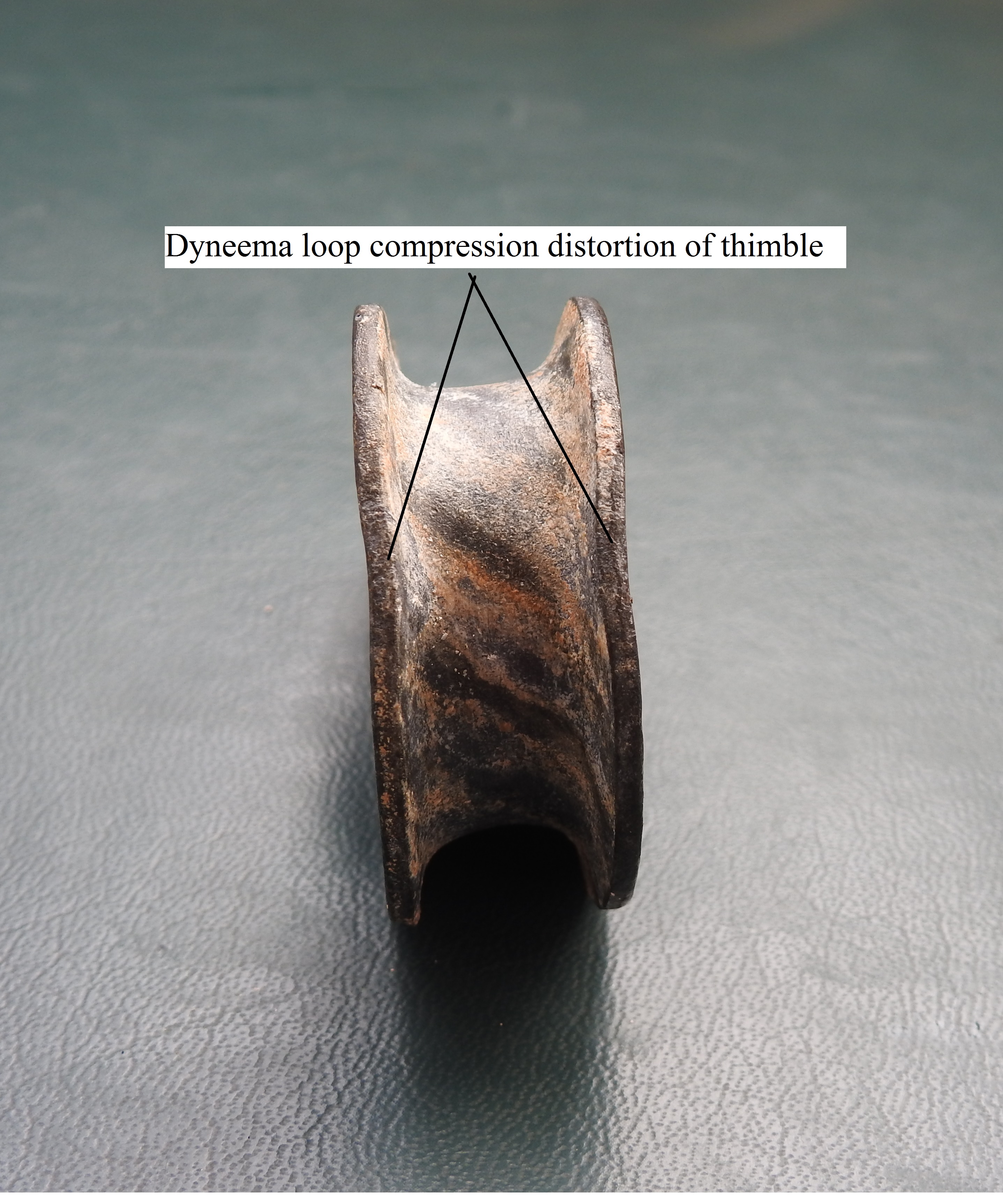
(surf). The photos of the galvanized thimble I think display just how
well the Dyneema loop can stay attached to the chain and thimble.
 |
| Fairly standard gal thimble, its easy to see the force the shackle was under during the storm |
 |
| Another angle of the thimble distortion |
 |
| Another angle showing the compressed distortion from the soft shackle |
Below
is a table I used as a starting point for putting together my
snubber. One important rule is that the lines must be nylon to afford
the required stretch. I have also found that it’s not the best to
deploy the full length of the snubber until I am anchoring in deeper
water (>7Metres) or I know a blow is coming my way. Like nylon
anchor rode the snubber can suffer abrasion if it is deployed onto an
abrasive bottom. As a rule I work out my water depth when anchoring
and set the snubber to just be above the bottom at low tide. So as an
example with a two metre draft and two metres under the keel plus two
metres from the cleat to the water line I will deploy a snubber
length of six metres. With a short snubber of six metres ten percent
stretch will give you over half a metre (0.6M) in moderate winds and
as the wind increases fifteen percent stretch would be just under a
metre (0.9M). The nylon will usually part (break) at twenty eight to
thirty five percent stretch depending on the brand. I have used
nylon rope one size down from the charted size e.g. 13M boat 12mm
snubber at full ten metre length when anchoring in soft mud. If used
regularly (daily) the snubber should be replaced annually due to
consistent stretch and UV degradation. Chafe protection will be
necessary as the snubber will come into contact with the anchor chain
regularly. A length of plastic tube approximately one metre long with
a three millimetre cord used to adjust position should suffice.
 |
| A heavy duty thimble spliced into the new springer, compare with a standard gal thimble bottom, there are even better thimbles with the tail welded and loops around the line to keep the thimble in place if the eye is under tension and stretched. . |
To
make a snubber is relatively simple, get a length of good quality
three core nylon to suit your vessel (see table below) and splice a
thimble or have a thimble spliced into one end is all that is needed.
If you want to use eight plait or climbing rope go ahead but it does
take a little more work. However, while it does look good for the
first month or so before it becomes camouflaged in the sea green if
used regularly, make sure you purchase heavy duty thimbles, sorry to
say you’re most likely not going to find these on the shelf of your
local discount chandler. Head off to someone who sells
rigging/lifting hardware, and for a few dollars more you will come
away with rope thimbles that won’t collapse in a big blow.
Keep
in mind that this table is a guide only, due to the various shapes
and sizes of vessels. An older mono hull vessel where the decks are
lower to the water line will have a lot less windage than some of the
newer builds with voluminous interiors and high sides. The same is
true with catamarans, the earlier builds were close to the water, and
now the newer builds with palatial cabins below decks and lounge
rooms above do offer a larger area to the wind.
Snubber Boat
Length Nylon Rope Diameter
Length
in Metres Feet Metres mm
6
25-30 7.5-9 10
8
30-39 9-12 12
8
39-44 12-13 14
10
44-50 13-15 16
12 50-60 15-18 18
Some
people say that with the long snubber bridle the chain is lowered
below the waterline so it affords better scope. I don’t believe
this is true, just look at the snubber in use in 25 knots or more of
breeze it can almost come clear of the water. For better scope you
would need to lower the attachment point on the vessel. The reality
is that the snubber connection to the chain should be well below the
water, if it’s not your snubber is too short or it’s blowing
really hard. I have found that at a minimum the chain/snubber
connection should just be above the bottom at low tide except when
anchored in soft mud deploy the full length snubber along with extra
chain. Perhaps a lower snubber attachment point (cleat) to achieve
better scope may work but it will be difficult to attach the snubber
on a cleat near the water line from up on the deck of the vessel.
 |
| Just on 25 knots the anchor chain is in a straight line to the anchor. Springer line has got a fair amount of stretch at this point. |
In
the season transitional storms mentioned earlier on, in one storm we
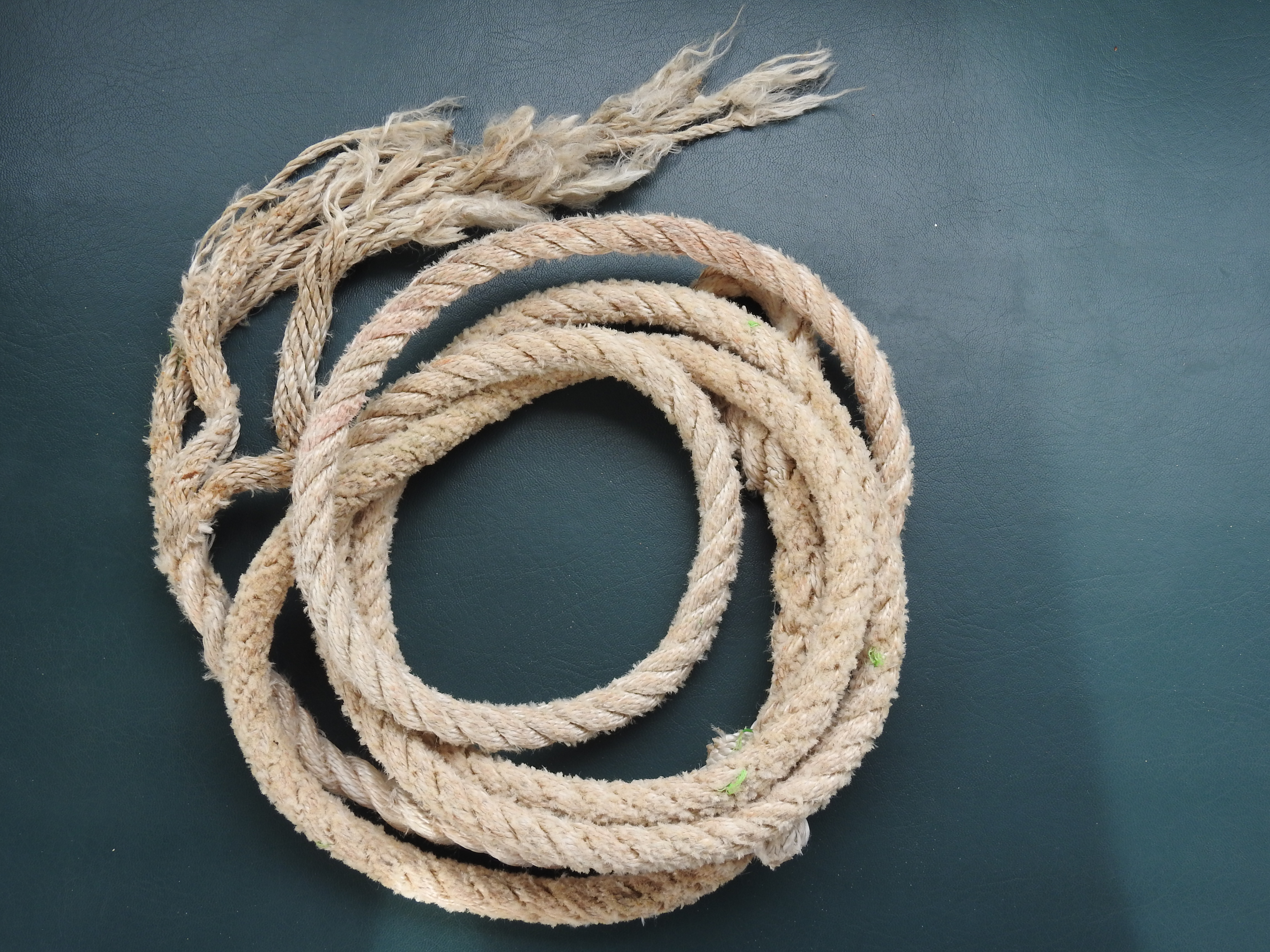
lost two snubbers due to them becoming over worked. It’s hard to
believe but the one snubber we were able to retrieve had the core
melted, it had become so hot absorbing energy. On inspection I found
it could not be unwound and had parted I believe due to heat. In
hindsight, if I had let out more snubber length earlier in the storm
the snubber would have been able to absorb the energy and would not
have become over worked.
 |
| The remains of the snubber the strands can not be unwound due to being melted together in the core. |
What
else in your anchoring system? Chain is without doubt the rode of
choice for cruising boats. It’s hard wearing and hard working. If
the bottom is abrasive it won’t wear through a chain easily where a
nylon anchor rod can be damaged in the course of an evening in the
right or should that be the wrong conditions. Get good quality marked
chain from reputable manufactures. Cheap chain with no identification
marks as to type or manufacturer has no place in the chain locker.
When you purchase chain always ask for the proof certificate, this is
a little bit of insurance your chain has been tested. Because you
have the certificate you now know that firstly you’re dealing with
a tested to failure product and secondly you know some quality
inspections have been carried out during the manufacturing process.
Another thing that is worth a mention is that it’s usually a better
option to purchase a chain from a manufacturer. Not from a dealer
(supposed chain manufacturing company) who sources the chain
manufacture out to another company, usually somewhere in China not
that that’s always a bad thing. During my work we got into all
sorts of problems with a manufacturing company who after years of
dealing with them, decided to outsource their chain manufacturing.
From time to time the supposed chain manufacturing company would
source a new manufacturer and twice during the changeover period
there was serious problems with chain quality. The down side for us
was that it was causing thousands of dollars loss through down time
and equipment damage when some chains failed. We had to find a new
supplier who would audit the manufacturer on a regular basis to
improve the product quality. For those of you who find this to be a
bit farfetched, I seem to recall something about an anchor
manufacturer out sourcing and having the odd bit of trouble.
So how
much chain do you need is totally up to you really, having just
completed a journey through SE Asia and anchoring in all sorts of
conditions and bottoms and now ten metres is the new five. Depending
on the boat and area of operation, I would say to start off with
eighty metres but one hundred would be better. One of our friends has
gone with eighty metres of chain and has fifty metres of nylon rope
he attaches for the really deep anchorages. He doesn’t lay the rope on the
bottom but deploys enough to keep it off the bottom at low tide, so
he rarely goes anywhere because he can have eighty metres of chain on
the bottom in deep anchorages. We are frequently anchoring in ten to
fifteen metres and one evening we anchored in twenty eight, yes every
last bit of our hundred and ten metres was out of the locker that
night.
Chain size? While not going over the top it’s better to have
more weight on the bottom rather than less. So if you think a high
strength chain of a smaller diameter sounds like a good idea it may
be false economy because you may find you need to let out more length
to get the weight on the bottom. This will then increase your swing
room and may be the difference of anchoring in a tight anchorage at
the end of the day or sitting outside in the weather. The other
factor no one appears to talk about is that the higher the chain
tensile strength the more brittle it becomes, this may not matter
where anchoring is concerned but it’s worth knowing about.
The
most important item in your system that will make it easy to find the
end of your chain is an anchor. So, how will you make the right
choice when it comes to selecting the anchor design that suits you?
It’s not quite as easy as you may have first thought and your
research options are certainly limited. If you take all the claims
and endorsements seriously and at face value you would really have a
problem making a choice.
 |
| The old tyre is not much of a springer, softer perhaps but not much good to keep you anchored in place. |
You
can read the manufacturers claims all day long and I am sure most
will excite you. But always keep in the back of your mind that they
are trying to sell you a new anchor made by them, the best bet is to
talk with other cruisers but take into account that its part of human
nature to defend even our worst purchasing decisions. I would
consider that it’s remarkable to talk to anyone who has never ever
dragged, as with the manufactures you can’t take every ones
comments at face value either. I remember a people’s behaviours quote my father would tell me about there being two types of sailors
in Moreton Bay, he would say that there are those who have run up on
a sand bar and then there are those who lie about it. However if you
ask enough people you may see patterns emerge especially if you ask
about other boats/persons anchor performance.
The
other way to consider a new anchor purchase is to look at the
independent testing results, these are most likely a reasonable bet,
but you do need to realize almost everyone has a schema. You will
also need to look at as many test results done by different people as
you can. This should help find the anchors that perform well just
about every time, lack lustre performance and hit miss results should
be enough to eliminate poor performers. I remember seeing anchor
tests over the years testing the same anchor and one will say that it
works fantastic in mud the next review states this anchor doesn’t
work very well in mud. The other hitch that I think confuses the
issue is the same or slightly changed press release doing the rounds
year after year with no new tests, it worked in tests years ago so
don’t retest just keep retelling the same great results, and where
and who by its earned accreditation.
I
have seen supposed true endorsement of anchors or accessories on line
and due to the over enthusiasm of the review and the known holes in
the story, I feel that somewhere or somehow money or goods have
conceivably changed hands. I have even read one review where an
anchor was blamed for electrolysis on the vessel due to a fault in
the anchor winch, but that was only one grievance amongst a long list
of others. Funnily enough the vessel never ever dragged again once
the new anchor was in place, which must have been a relief for the
captain because it had moved every time they anchored with the
previous anchor. Somehow I just don’t believe it, knowing the
reputation of the anchor they put on.
Without
doubt the new generation anchors worked the best during the storm in
question, but that said one brand didn’t work as well as the
manufacture's would like us to believe. If the anchor is based on an
old design with a few changes then really do your homework, if they
just turn in a satisfactory or good all-rounder during anchor tests
then think again and look for exceptional holding because that’s
what we all want at three in the morning on a hot and windy night. But
the thing we all need to keep in the back of our mind is the fact
that like the weather the holding is only as good as what you are
experiencing right here, right now in this small patch of the ocean.
But if our vessels are set up to help keep us anchored to this small
patch of ocean floor we may all be able to sleep better.
With
a new anchor purchase you will find an anchor that is larger than the anchor manufacturer recommends is well worth while but it’s your call
whether it can be fitted and carried safely. With anchors, bigger
equals more surface area and more weight and both will help you stay
put. I know the old guys who sprout the virtues of the old generation
anchors are in most cases using an anchor a minimum of two, three or
even more sizes up from what the manufactures originally recommended. There is nothing wrong with that mind you, however it is more expensive to fit the vessel out with a bigger anchor and sometimes anchor winch.
It is important to note there are several manufactures who promote under sized anchors. Why? basically so they can sell more anchors. Yacht manufactures look at ways to save money so if an anchor manufacturer specifies that a 40' yacht only needs a 16 Kg anchor and the opposition list a 20 Kg as being suitable my bet is that the manufacturer is going to be going for the lighter and cheaper option.
While all the advertising sprouts the certifications making it all sound wonderful to be classed as a high holding anchor, from our experience we believe the selection charts promote the fitment of undersized anchors. While these anchors are good for a lunch time stop in a peaceful bay they certainly will not allow you to sleep overnight during a stiff breeze, let alone a storm. I think the old guys had it right with upsizing their anchors, they had too, and I believe we need to continue with it and fit an anchor at least two sizes up from what is recommended.
 |
| Staged set up, hooking up the springer to the anchor chain |
 |
| Staged again, the loop shown is certainly not big enough but to give an idea of how it will look deployed |
 |
| Got it right the soft shackle is just on the bottom at low tide lots of chain loop for stretch. |
In
conclusion, if your anchor dislodges during a storm you will have to
make the call on whether to re anchor during a blow. I know several
vessels tried and tried but due to the wind pushing them back and in
some cases turning them side on to the wind the anchors would not
set. One vessel close to us really had us worried because several
times he almost collided with us as he tried in vain to get his
anchor to set when re anchoring. During a storm if you have control
of the vessel with the motor running now may be the time to hold her
nose into the wind and tread water until the blow eases. Go for a
drive as you wait, it’s got to be better than exhausting yourself
and crew. As we have experienced time and time again voices get
raised and fingers have sometimes been put in the wrong place at the
wrong time due to the stress and anxiety of the situation when trying
to anchor in difficult circumstances which doesn’t do anyone any
good.
Poor performance of some anchor winches
During
the storm one thing that did turn up as a factor in the problems
people faced was the poor performance of some anchor winches. Most of
this turned out to be due to lack of maintenance or delayed repairs.
If you are having an anchor winch problem that requires you to jiggle
wires or the winch doesn’t stop when hauling in and trips the
circuit breaker when the anchor is driven home, fix it before it
catches you or someone else helping you out. If you’re in a blow
by the time you get to the hospital most of the time they won’t be
able to sew that finger back on. There were a lot of different winch
problems on the night in question and I know of one boat becoming a
figurehead on the bow of another boat because his winch failed to
pick up fast enough. The reason it was so slow was due to lack of
winch maintenance. The maintenance for this winch was to simply
remove the shaft clean off any residual sand, mud and organic matter
and then grease the bearings and moving parts on a six monthly
schedule. An easy but slightly dirty job, but in five years it had
never been done.
Check
and grease your electrical connections on the winch regularly, don’t
use Vaseline or a lanoline based grease for this job due to the low
melt point, it will just become liquid and run off the terminals the
first day in the sun. Use a heavy duty marine grease and smear it on
after making clean dry electrical connections. This will stop moist
air entering the good clean connections creating corrosion. A small
note: marine wheel bearing grease works a treat because it’s made
to get hot and not turn to liquid.
Get
yourself a spare hand controller if your winch is set up that way,
the failure rate of the plugs, cables and buttons is high enough to
warrant an easily plug in hot spare. Make sure the plug and sockets
of the hand controller are water tight, some are just splash proof,
and that just doesn’t cut it on the front deck or in the anchor
locker of a cruising boat in a storm. All plugs and hand pieces
should have an IP number, this rating will be an indication to how
water tight the connection will be. The IP guide states that IP67: No
ingress of dust; complete protection. Ingress of water in harmful
quantity shall not be possible when the enclosure is immersed in
water up to 1 m of submersion. However this will mean the housing and
the plug have been assembled as per the instructions, that is the
wire going into the plug back shell and the case/buttons must have
all the rubbers/O-rings etc to attain water resistance.
 |
| A sad sight unprotected anchor winch relays removed from the chain locker |
Get
under the deck or inside the winch cover to check solenoid
connections, these should be assessed on a regular basis, this
doesn’t take a lot of time, a quick inspection and jiggle the wires
and connectors should spot any corrosion or water ingress that will
then require repair. If the vessel is new to you or you have had work
done make sure the forward/reversing solenoid is wired correctly. One
vessel had a miss-wired solenoid block and while it still worked it
didn’t work very well. Unfortunately this work was carried out by a
paid professional who was either colour blind in a hurry for the next
job or just wanted to get home. A note: if you’re on an extended
voyage offshore get a spare set of anchor winch solenoid(s) in the
spares kit, due to the variations in solenoid(s) they are not
available everywhere off the shelf.
The
large foot operated winch control buttons installed in the fore deck
can also fail if the installer uses too much sealant causing a
blockage of the drain holes. Without drainage any water/condensation
remains trapped and will quickly cause enough corrosion to stop the
switch working.
As
far as I can see, most of the catamaran owners have this
snubber/bridle thing down pat due to necessity, but without the same
necessity unfortunately a lot of mono owners both sail and power are
missing the point. While some catamaran owners do from time to time
use the wrong type of rope on the snubber or perhaps tie off a little
too short it’s usually the mono-hulls that don’t have long enough
or the right type of snubbers or in some cases don’t have an
effective snubber at all.
A
week after writing the majority of this, we were anchored in a
reasonably crowded anchorage. Although crowded there was a fair
amount of room, and the bottom was good holding sticky mud in six
metres of water. Because I have snubbers and anchoring techniques on
the brain at the moment I took a little more notice of the vessels
around us. I am sorry to say that of the thirty or so vessels in the
anchorage only a few had anything that looked remotely like an
effective snubber anchoring system. One vessel was using what looked
like an old dock line rubber mooring springer. Very few had enough of
a chain loop to allow the snubber to stretch effectively, so I can
only surmise the short rope in use didn’t have much stretch in the
first place. I also noticed two vessels had very short lines (300mm)
in use that would only be good to take the strain off the anchor
winch. Two vessels were using silver rode, after watching them
anchoring I would guess they laid out about 8 to 10 metres of eight
millimetre chain then a lot of rope. I could go on but it would be
much of the same with small changes in snubber rope diameter etc.
After a particularly nasty storm several vessels were not where they
were before the storm. I observed the usual suspects, plows, deltas
and claws were retrieved from the bottom when they pulled their gear
up to re-anchor. Luckily there was no collisions but I watched two
vessel take notice when there old neighbors re-anchored in front of
them, funnily enough they then hauled anchor and moved a safe
distance away.
Oh
yeah, so what’s my schema? Hopefully to make a people stop and
think, can I anchor a little safer than what I am doing now? And in
doing so remove the grief that comes from being blown backwards
through a crowded anchorage at three in the morning, with your wife
waking you up to ask you why everyone is leaving the anchorage yah
better get up and have a look!